By a Welder
Who gets into the trade, what actually builds them, and why the systems meant to deliver the next generation keep failing.
For Daz
The late Darren Jefferies, one of the best lecturers I ever met.
Daz was another one cut from the very mould this paper describes. This one’s for you, mate.
Industry Endorsement
Eddy Derwort | Senior Welding Engineer, Bradken
I’ve read The Making of a Welder, and it stopped me in my tracks because it’s the story of me.
I left school as soon as I could. I was disengaged, switched off, and academically heading nowhere. It was an apprenticeship that changed everything.
For the first time, I was motivated and engaged. The learning environment at Wembley TAFE suited me perfectly. I can still remember the names of most of my lecturers because they took an interest in me, believed in me, and helped me see potential in myself that I’d never recognised before.
In the workplace, I was so fulfilled that I couldn’t wait to get to work each morning. I used to sing all day because I finally had something real to do and a clear sense of purpose.
This paper puts its finger on what two decades and more of “trade shortage” policy have largely missed.
Good welders often come from the very students our classrooms serve least effectively.
What turns them around isn’t an aptitude test or a simulator score. It’s an adult who believes in them, and work that allows them to create something rewarding by the end of the day.
As a former Apprentice Master to around thirty apprentices and a qualified NATA assessor, I’ve seen it firsthand: the moment a young person’s eyes light up and they realise they’re capable.
I’ve also watched the system make the journey harder than it needs to be. I remember one young bloke being sent all over Perth to different TAFEs just to complete his welding modules because no streamlined pathway existed.
The paper identifies a credible solution because it focuses on the very person we’ve overlooked for too long: the disinterested boy/girl at the back of the classroom.
Schools, career counsellors, parents, and guardians should read this.
It offers valuable perspective and reminds us that a trade is a journey, not a destination. Maybe your child doesn’t have “learning difficulties” at all.
Maybe the system simply doesn’t accommodate his/her learning needs.
Graham has earned the right to say what he says.
He’s walked the very familiar path, carries the burn marks on his arms, understands what we’re asking young people to take on, and possesses the knowledge that only comes from years in the trade.
This paper must be read by anyone serious about preparing young people for an uncertain future shaped by AI.
It should also be read by every parent, guardian, educator, and policymaker.
Self-actualisation for our young people is one of the best investments we can make as a society.
When young people find purpose, identity, and meaningful work, we all benefit.
Keeping youngsters engaged in meaningful learning and work is one of the best antidotes to youth crime, because boredom, disengagement, and a lack of purpose rarely produce positive outcomes.
What this paper argues
- The headline 70,000 shortfall has no published methodology. The defensible gap is 25,000-30,000 additional welders by 2030. Still serious, but plan off a real number.
- Good welders come disproportionately from the students our schools serve worst: adolescents, mostly boys, who disengage in Years 8 to 10. The fix is developmental, not moral.
- What turns those kids into tradespeople is an adult who believes them capable, an early win they can hold, and work that makes something real. The psychology is settled.
- Aptitude testing does not select for interest, conscientiousness or acceptance of the work. Work samples and realistic job trials predict who stays.
- AR and VR simulators address a fraction of one competency. Useful for first exposure. No independent replication exists for the headline vendor numbers as at July 2026.
- The trade is a platform, not a dead end. The ladder from tradesperson to International Welding Engineer already exists. We tell no Year 9 student that.
Executive Summary
The world is short of welders. The American Welding Society projects around 320,500 new welding professionals needed in the United States by 2029, and scaled pro rata to population that puts Australia’s realistic gap at 25,000 to 30,000 additional welders by 2030, a range consistent with Jobs and Skills Australia data and Manufacturing Industry Skills Alliance modelling. The figure quoted far more often, a 70,000 shortfall by 2030, has no published methodology behind it and does not survive contact with arithmetic; this paper deals with it in its opening chapter, because a policy conversation built on an unsupported number makes bad decisions.1 Germany, Japan and the United Kingdom report the same trajectory. Every industrial economy has spent a decade describing the problem, funding campaigns, buying technology and reforming training packages. The shortage has got worse.
This paper argues the reason is simple and uncomfortable. We keep trying to fix the supply of welders without ever asking the questions that sit underneath it. Who actually becomes a good welder? Where do they come from? What does the trade actually consist of? And who is qualified to answer?
The answers this paper puts forward, each backed by the strongest evidence available and each tested against the counterarguments, are these.
Good welders come disproportionately from the group our school system serves worst: adolescents, mostly boys, who disengage from academic classroom learning in Years 8 to 10, at exactly the point their development demands autonomy, competence and real-world relevance and the school system responds with more control, more abstraction and more sitting still. This paper is unapologetically written around those boys, for reasons declared openly in its third chapter: they are the trade’s overwhelming intake, the school system’s clearest casualties, and the cohort every new industry announcement now forgets. The evidence and the fixes serve everyone. The perspective is declared, and it is lived. NSW audit evidence within two years of the raised leaving age showed Year 11 students more absent, more suspended and more disengaged than before the change, while for the less academically inclined male who secures a trade pathway, Year 11 plus an apprenticeship matched or beat Year 12 completion in wage terms.2 We are warehousing the very kids the trades need, then wondering where the apprentices went.
What turns those kids into tradespeople is not a test score. It is an adult who believes them capable, an early mastery experience they can see and hold, and work that produces something real at the end of the day. The psychology on this is mature: mastery experience is the strongest builder of self-efficacy, expectation effects are strongest for exactly the low-expectation students the trades recruit, and work high in task identity and feedback, which describes welding almost perfectly, is reliably associated with satisfaction and motivation.3
Traditional aptitude testing does not select for any of that. The 2022 re-analysis of a century of selection research cut the estimated validity of general aptitude testing for job performance by more than a third, and four countries’ worth of apprentice attrition data says the same thing: apprentices overwhelmingly quit over the employer relationship, the workplace and mismatched expectations, not because they lacked tested ability.4 What predicts survival in the trade is interest fit, conscientiousness and a clear-eyed acceptance of the environment: hot, cold, dirty, dark, dusty and dangerous. The evidence-based selection tools for that are work samples, realistic job previews and hands-on trials, not paper tests.
AR and VR welding simulators, sold as the technological fix, address a fraction of one competency among the dozens a welder must hold, and as at July 2026 no published methodology or independent replication could be located for the headline vendor numbers behind them. The independent evidence supports a narrow role at the very front of training and nothing more. The wider competency stack, machine setup, consumables, distortion control, reading a live puddle, diagnosing a misbehaving machine, working a real shop floor, cannot be simulated at any price the training system can pay.
The trade itself needs repitching: not as a destination for kids who failed at school, but as a journey and a platform. A welding trade is the foundation under supervisors, inspectors, QA managers, project managers, draftspeople, business owners, welding engineers. The international ladder from tradesperson to International Welding Engineer already exists. Germany pegs its master tradesperson qualification at the same level as a bachelor degree, unfortunately Australia puts a barrier there. We tell none of this to a single Year 9 student, their parents, or the counsellor advising them.
And the people designing the fix need to change. Trade training policy is written overwhelmingly by people who have never walked the path, have the burns on the forearms and can not genuine talk from a point of empathy or understanding. The tacit knowledge of those who have, the practitioners who know what the trade demands because they have lived it, is the single most under-used asset in the system.
None of this requires a moonshot. It requires promoting trades collectively rather than competing for the same shrinking pool, replacing paper aptitude gates with try-a-trade selection that works, restoring practitioners to the centre of training design and delivery, revisiting the existing pathways for Certificate III and explore more just new models, using simulators for what they are actually good for and nothing more, and telling young people and their parents the truth about what a trade is: a foundation you can build almost anything on.
We cannot keep doing what we have always done and expect a different result. The kids are there. The jobs are there. The system between them is the problem.
A Shortage We Keep Describing and Never Fix
The numbers have been rehearsed so often they have lost their power to shock, so start by getting the Australian number right, because the one in circulation is wrong.
The figure that headlines almost every Australian conversation about this trade is Weld Australia’s projection of a 70,000 welder shortfall by 2030, first published around 2022 and repeated since in industry media, conference presentations and government submissions.5 As at July 2026, no published methodology, demand model or workforce baseline behind that figure could be located, and the organisation is welcome to supply one. Until it does, the number has to be tested against arithmetic, and it fails twice.
First, against the size of the trade itself. Jobs and Skills Australia’s occupation data puts the structural steel and welding trades workers group at roughly 74,300 people.6 A 70,000 shortfall by 2030 asserts a gap nearly the size of the entire existing national workforce, opening up inside a handful of years. Even read charitably, as retirements plus growth plus the energy transition stacked together, the components have never been published, so the charitable reading cannot be tested either.
Second, against the international benchmark. The American Welding Society projects around 320,500 new welding professionals needed in the United States by 2029, with more than 157,000 welders approaching retirement and fewer than one in ten current welders under 25, and unlike the Australian figure, the AWS projection is built on published workforce data.7 Australia has roughly one-twelfth of the American population. Scale the AWS projection pro rata and Australia’s gap lands at 25,000 to 30,000 additional welders by 2030, which is also where Jobs and Skills Australia data and Manufacturing Industry Skills Alliance modelling of roughly 17 per cent manufacturing demand growth point.8 For 70,000 to be right, Australian per-capita demand for new welders would have to run at nearly three times the American rate, in a far smaller manufacturing economy. Nothing published anywhere supports that.
So this paper uses 25,000 to 30,000 by 2030, and it is worth being clear about why the correction matters rather than being pedantry. A gap of 25,000 to 30,000 against a workforce of 75,000 is a genuine crisis on its own numbers; it needs no inflation. Inflated headline figures corrupt the policy response in a predictable direction: they manufacture panic, and panic buys the fast fixes, compressed sign-offs, simulator hours counted as training, lowered bars, that this paper spends its later chapters dismantling. They also hand sceptics a free kick, because the moment one number collapses under scrutiny, the whole shortage case gets dismissed with it. The trade’s advocacy deserves the same evidentiary standard this paper demands of simulator vendors. Real numbers, published workings, or no number at all.
What the verifiable record shows is serious enough. Jobs and Skills Australia’s 2025 Occupation Shortage List confirms Welders (First Class) remain in national shortage, and the technicians and trades group as a whole recorded a vacancy fill rate of about 57 per cent, the worst of any occupational cluster.9 Germany’s metal and electrical trades sit permanently on the federal shortage occupation lists, with the Cologne Institute for Economic Research estimating hundreds of thousands of unfilled skilled positions across the economy each year.10 Japan’s demographic arithmetic points the same way, and the United Kingdom lists welding trades on its immigration shortage occupation lists while apprenticeship starts for under-19s have fallen roughly 40 per cent since 2015.11
Behind the projections sits the on-the-ground reality. Weld Australia’s own member surveys report workshops operating at 80 per cent capacity or below, with seven in ten members saying the work is there but the people are not.12 The Australian Steel Institute’s 2024 survey found 80 per cent of fabricators operating below the capacity utilisation they need to break even.13 Trade apprenticeship contracts in training fell another 3.2 per cent in the year to March 2025, and the six-year completion rate for apprentices who started in 2018 was 58.2 per cent.14 More than four in ten people who start never finish. That has been true for a decade.
Twenty-five years of national skills policy has been aimed at this problem. The conversation itself is not new; the National Centre for Vocational Education Research was publishing on trade skill shortages before some of today’s apprentices were born. What has changed is the demand side. Defence programs, energy transition infrastructure, transmission builds and an ageing asset base have collided with a workforce where roughly 30 per cent of welders are over 45 and the training workforce meant to replace them has a median age of 50.15
So the question this paper asks is not ‘is there a shortage’. Everyone agrees there is. The question is why a problem this well documented, this well funded and this heavily reformed keeps getting worse. The answer offered here is that the interventions have consistently aimed at the wrong targets, because the people designing them, and practitioners are consulted on content but rarely hold the pen on design, funding or assessment policy, have never asked the foundational questions: who becomes a good welder, what does the trade actually consist of, and what makes someone stay?
Answer those three questions honestly and the policy failures explain themselves. The pipeline fails at the school gate because the kids most suited to the trade are being held somewhere they cannot succeed. Selection fails because we test for the wrong attributes. Training fails because it has drifted away from the people who hold the trade’s knowledge. Technology fails because it addresses a sliver of the job and gets sold as the whole. And retention fails because nobody repitched the trade as something worth staying for.
Each of those claims gets its own chapter, its own evidence, and its own counterargument.
The Boy at the Back of the Classroom
Start where welders actually come from. Not from careers expos. Not from marketing campaigns. The trade’s natural intake has always been the kid, most often a boy, who stopped engaging with classroom learning somewhere around Year 8 or 9, who is competent with his hands, restless behind a desk, and increasingly convinced that school has nothing for him.
Written around boys, on purpose
Before the data, a declaration. This paper is unapologetically written around boys, and there are three reasons.
The first is honesty about perspective. It’s the best vantage point I have. It’s where I started, it’s what I lived, and the people I’ve trained, supervised and qualified across forty years in this trade have been overwhelmingly boys and men. When I write about the boy at the back of the classroom, I’m not theorising from a literature review. I was that boy. So were most of the blokes I went through trade school with, and most of the ones I grew up alongside in the trade. All of a similar mould: disengaged from school not because they were incapable, but because the place didn’t fit. It didn’t align with how they learned or what held their interest, and without interest, ramming information down a young person’s throat doesn’t work. It never has. Create the interest and they swallow it without even asking. That said, along the way I have certainly empowered, trained and shown exactly the same belief in young women, and it has given them equal or greater opportunity. The belief works the same way whoever is holding the torch.
The second is family. I have a daughter, and I’d back her into any field she chooses, trades included, I encouraged time in the shed with her, showed her at a very young age how to use a drill, a paint brush and a welder. I also have a son, and I want to equally assist him to find his way. That gives me a second vantage point rather than cancelling the first: boys and girls are different, and pretending otherwise serves neither of them.
The third is that boys are being quietly forgotten. I would dearly love to see a broader spread of gender across the trades. From what I’ve watched on shop floors, young women and women alike bring traits into this industry that add real value, and every reform in this paper is built to work for them. But watch the announcements. Every program launch, every funding round, every industry PR story pushes a young woman to the front of the photo. That has value, and it should continue. Somewhere in the race to demonstrate inclusivity, though, the cohort that makes up the overwhelming majority of the trade’s intake, and the overwhelming majority of the disengagement statistics that follow, stopped being talked about. Nobody builds a program for the boy at the back of the classroom anymore. This paper does, without apology. The girls are welcome on every page of it. The boys need the support as well, and right now they are the ones the system is losing.
Let me be plainer still, because this paper will be read by people looking for a side to put me on. I am not against bringing more women into this trade. The opposite. A later chapter lays out the evidence on what women bring to a welding shop, and it is compelling enough that I’d argue the industry’s one per cent female participation is one of its great wasted resources. What I am against is young boys being caught up in the ‘inclusivity debate’, made to feel like yesterday’s problem while the programs, the photos and the funding chase a different story. Backing the boy at the back of the classroom and opening the shop door wider for his sister are not competing projects. It isn’t about him or her. It is about ensuring equity and equality for everyone coming through, and any policy that treats them as a trade-off has failed both of them.
The data on that kid is stark, and it is national.
By Year 9, 44 per cent of Australian boys fail to meet writing standards in NAPLAN, roughly twice the rate of girls, a gap the Centre for Independent Studies’ analysis of the 2025 data puts at the equivalent of more than 21 months of learning. Longitudinal analysis of NAPLAN identifies the primary-to-secondary transition as the point where boys’ literacy achievement deteriorates.16 In PISA, Australian girls outperform boys in reading by 22 points, and a quarter of Australian boys score below the baseline proficiency level. The OECD’s own analysis found boys are eight percentage points more likely than girls to say school is a waste of time, and attributed the gaps to attitudes, behaviour and engagement rather than ability.17
Engagement tracking shows a measurable dip beginning in Year 8, within students, not between cohorts.18 The Grattan Institute estimated that as many as 40 per cent of Australian students are unproductive or disengaged in a given year.19 A decade-long cohort study of more than 72,000 NSW public school students found 19 per cent were suspended or expelled at least once, with boys around twice as likely to be suspended once and roughly ten times as likely to be suspended sixteen or more times.20 Adolescent boys are diagnosed with ADHD at around three times the rate of girls.21
None of this is a revelation. A House of Representatives inquiry reported on it in 2002 under the title Boys: Getting it Right, found that boys respond worse than girls to irrelevant curriculum and poor teaching, and made 24 recommendations.22 Most were never implemented. Twenty-four years later the same cohort is still sitting at the back of the same classroom.
Why the mismatch is developmental, not moral
The lazy reading of this data is that the boys are the problem. The evidence points the other way: the mismatch is between what mid-adolescents developmentally need and what secondary school structurally provides.
The framework with the strongest research pedigree here is stage-environment fit. Eccles and Midgley showed three decades ago that adolescent disengagement is produced when young people’s developmental needs, autonomy, visible competence, real-world relevance, adult-like roles, collide with school environments that respond to adolescence with more control, lower-level cognitive tasks and less autonomy.23 That finding has been replicated across decades and countries. The adolescent brain research points the same direction, provided it is used carefully: the executive systems that support abstract planning and delayed reward continue maturing into the twenties, and reward-seeking peaks in mid-adolescence while regulation lags.24 Some developmental evidence suggests boys on average, and with wide individual overlap, mature later on precisely these systems.25
To be clear about what this paper is not claiming: there is no credible evidence for ‘kinaesthetic learners’ as a category of brain, and this paper does not rely on learning styles theory, which has been comprehensively debunked.26 The defensible claim is different and stronger. Applied, hands-on, work-connected learning delivers the things mid-adolescents developmentally require: visible competence, autonomy, relevance and adult treatment. A workshop gives a fifteen-year-old something a worksheet cannot: evidence, at the end of the day, that he can do something real. Victoria’s own review of applied learning pathways credited exactly these principles with re-engaging at-risk students.27
The Year 12 retention experiment has been run, and audited
In 2009 and 2010, every Australian state adopted the ‘earning or learning’ compact and raised the effective leaving age to 17. The policy intent was sound. The execution assumed that a disengaged fifteen-year-old kept in a classroom becomes an engaged seventeen-year-old with better prospects.
The NSW Auditor-General tested that assumption in 2012 and the findings deserve to be quoted rather than paraphrased. After the leaving age rose, one in eight Year 10 students, 6,912 of 54,607, were unaccounted for in Year 11, with the department unable to say where they were. And directly: ‘Year 11 students now are absent more often and more likely to be suspended than those in previous years… more students who remain at school until 17 are disengaged. There is a risk that disengaged students not only disrupt others but also waste teachers’ time.’28 Subsequent Melbourne research estimated upwards of 50,000 compulsory-age students detached from any enrolment at all, invisible in the retention statistics that make the policy look successful.29
Meanwhile the strongest matched-comparison study in the country asked the question that actually matters: for the less academically inclined student, is Year 12 completion worth more than a trade pathway? NCVER’s analysis of the Longitudinal Surveys of Australian Youth found that for males, all vocational pathways, including early leaving followed by VET, were equivalent to Year 12 completion in labour-market terms at age 25. And one comparison stood out: Year 11 plus an apprenticeship was superior to Year 12 in wages for full-time workers.30 The only advantage Year 12 retained was entry to diploma-and-above study, which remains open to a tradesperson later in any case.
The international economics cuts the same way once you read it properly. Compulsory schooling studies in Canada and the UK found earnings gains for would-be early leavers, and those studies are regularly cited in defence of retention policy. But the German version of the same natural experiment found zero returns to additional compulsory schooling, and the explanations offered centre on German students acquiring core work-relevant skills earlier, inside a system that then channels its non-academic students into structured apprenticeships, so the extra classroom year added little the pathway was not already providing.31 Extra compulsion pays off only where the extra time is spent on something useful. Where a strong vocational pathway exists, forcing the academic alternative adds nothing and costs plenty.
The cost side is measurable in behaviour. Repeated academic failure is not motivationally neutral. Covington’s self-worth research showed decades ago that students who cannot win the academic game protect themselves by withholding effort, self-handicapping and disrupting, which any Year 9 teacher will recognise as a Tuesday.32 School disengagement predicts dropout, delinquency and substance problems into early adulthood.33 Suspension, the system’s main response to the behaviour it produces, independently predicts later antisocial behaviour.34 And the endpoint of the pipeline is the NEET statistics: 288,000 Australians aged 15 to 24 not in employment, education or training as at May 2024, up from around 7.6 per cent of the age group in 2022 to 8.5 per cent.35
What the alternative looks like when we actually run it
The counterfactual is not hypothetical. Every time the system offers the disengaged cohort an applied pathway, the results repeat.
Students who took school-based apprenticeships were among the most likely of any school cohort to be in full-time permanent employment five years later, with around four in five of the broader VET-in-schools cohort employed within four to five years, and school-based apprentices the most likely to be working in an occupation relevant to their training.36 Longitudinal survey analysis finds VET in schools improves attitudes to school and Year 10 to 11 retention, the exact outcome the leaving-age legislation was reaching for.37 Around three-quarters of early school leavers re-engage with education by age 25, overwhelmingly through VET.38 The system gets them back. It just gets them back later, poorer and more bruised than it needed to.
The in-school programs built on applied learning tell the same story. Hands On Learning, which takes disengaged Years 5 to 10 students out of the classroom one day a week to build real projects, was assessed by Deloitte Access Economics as returning around twelve dollars for every dollar invested, with independent analysis finding 76 per cent post-school employment for participants against 45 per cent for comparable non-participants.39 The 2014 independent review of the Trade Training Centres program recorded individual schools reporting retention of young Aboriginal boys rising to 80 or 90 per cent, and one school reporting a six-fold increase in boys staying to Year 12, with three-quarters in full-time work within a year of graduating.40
Read that last one again. Giving boys a trade pathway did not pull them out of Year 12. It kept them there. The point of an earlier trade pathway is not less education. It is education that fits, delivered in a form the student can succeed at, with the academic layer available later when maturity and motive arrive. The square peg is not the problem. The insistence on one round hole is.
The question is ‘who are we serving by ‘strongly encouraging’ students to complete year 12? The credibility of the system? Our obligation is to the best interests of the student.
Many of the successful people I know with a trade background, never completed year 12, myself, included.
Someone Has to Believe Them Capable
Ask any tradesperson over forty how they got into the trade and you will hear a version of the same story. Somebody saw something in them. A teacher who let them into the metalwork room at lunch. An uncle who put a grinder in their hands. A first-year supervisor who said ‘you’ve got a feel for this’ at exactly the moment school had finished telling them they had a feel for nothing.
That story is not sentimentality. Mine came in a fabrication shed from a Scottish welder whose exact words are in the chapter that follows, and it is three of the most robust findings in psychology, wearing work boots.
Expectation effects, claimed carefully
The famous version is the Pygmalion effect: tell teachers a student will bloom and the student blooms. The original 1968 study has been fought over for fifty years, and this paper will not lean on it naively. The honest summary of the modern literature is that expectancy effects in classrooms are real but typically small, and teacher expectations mostly predict outcomes because they are accurate.41
But two qualifications in that same literature matter enormously for the trades. First, self-fulfilling prophecy effects are strongest for students from stigmatised, low-expectation groups.42 The kid who has spent three years being told, implicitly and explicitly, that he is not academic material is precisely the person on whom genuine belief has its largest effect. Second, the strongest expectancy results on record come not from primary classrooms but from adult training environments. A meta-analysis of Pygmalion studies in management and military training found large average effects, strongest in military-style instruction, with men, and with trainees initially held to low expectations.43 Structured instruction of young men who arrive with low expectations of themselves is a fair description of first-year apprentice training. The instructor’s genuine belief is not a soft factor. It is an active ingredient.
And it can be taught. Rubie-Davies’ New Zealand intervention trained teachers in the observable practices of high-expectation teachers, and their students gained the equivalent of roughly three additional months of mathematics learning in a year, across demographics.44 Nobody has yet tested the intervention in a welding bay, but the underlying practices, challenging work delivered warmly, visible goals, refusal to stream by presumed ability, are trade training’s home ground.
Mastery is the engine
Bandura’s self-efficacy research, one of the most cited bodies of work in psychology, identified four sources of a person’s belief in their own capability, and ranked them. Verbal encouragement is the weakest that matters. Watching someone like you succeed is stronger. The strongest, by a distance, is mastery experience: doing the thing and seeing it work.45 Self-efficacy in turn correlates with work performance at around .38 in meta-analysis, a large effect by workplace standards.46
Now look at what welding hands a learner. A fillet weld is a mastery experience you can hold. It exists, it is yours, it either passes visual inspection or it doesn’t, and when it does, no one can take it off you. The feedback is immediate, physical and unarguable. Compare that with the feedback loop of a Year 9 essay: days later, mediated through a teacher, graded against invisible criteria, in a currency the student has already stopped believing he can earn.
This is why the workshop reaches kids the classroom cannot. Not because their brains are a different type, but because the work itself is structured the way self-efficacy is actually built: attempt, result, adjustment, visible progress. Every pass of the grinder, every tack that holds, is a deposit in an account that school had emptied.
This same sense of ‘mastery’ and the emotion that is ‘felt’ by touching and feeling the results of the students efforts is part of the short comings of a ‘simulator’. For it to work, the success needs to be real, not computer binary 1’s and 0’s.
Work you can point at
The industrial psychology says the same thing from the other direction. In the Job Characteristics Model, the two features of work most relevant here are task identity, completing a whole identifiable piece of work, and feedback from the job itself. Meta-analysis across a quarter of a million workers confirms these characteristics reliably predict satisfaction, motivation and commitment.47 Meaningful work, in a 44-study meta-analysis, shows large associations with engagement and satisfaction and moderate-to-large associations with life satisfaction and health.48 Welding is close to a textbook case of high task identity and high intrinsic feedback: the welder starts a joint, finishes it, and can point at it, sometimes for the rest of their life. Ask a welder about a job they did twenty years ago and they will drive you past it.
The philosophical literature made this argument before the psychologists measured it. Crawford’s Shop Class as Soulcraft and Sennett’s The Craftsman both dismantle the assumption that manual work is mindless, and both locate its satisfaction in exactly the features above: judgement exercised on resistant material, standards that cannot be argued with, output that exists.49 The survey data agrees: NCVER’s outcomes survey has trade completers at 94.8 per cent employment with satisfaction levels in the nineties, and US skilled trades surveys consistently report career satisfaction around 90 per cent.50
Role models, in a trade full of broken starts
One more strand belongs here, and it needs saying plainly because policy documents tiptoe around it. A significant share of the young people the trade takes in are carrying disrupted families, absent parents, and no consistent adult male presence. One-parent families passed one million in Australia at the 2021 Census, around 16 per cent of all families, roughly 80 per cent of them headed by mothers.51 The rigorous causal literature on father absence, stripped of both denial and moral panic, finds real negative effects concentrated exactly where this paper has been looking: high-school completion and boys’ externalising behaviour.52
What buffers that risk is also well measured. The flagship randomised trial of youth mentoring found mentored at-risk youth 46 per cent less likely to initiate drug use and markedly better attached to school.53 The meta-analytic average across the field is modest, but the effects are consistently largest for young people carrying pre-existing risk, and particularly for boys.54 Natural mentoring research adds the sting: the more risk factors a young person carries, the less likely they are to find an informal mentor on their own.55
A trade workshop is one of the last institutions in the country that supplies that relationship as a by-product of its normal operation. The master-and-apprentice structure is a mentoring program that doesn’t call itself one: a skilled, invested adult, daily contact over years, standards, correction, and belief backed by demonstration. The evidence on matching is clear that the mentor does not need to be male; same-gender and cross-gender matches produce equivalent outcomes, and what matters is that the adult is credible, skilled and stays.56 The growing cohort of tradeswomen widens the field of kids who can look at a welder and see themselves. What cannot be substituted is the presence. For a fifteen-year-old with no functional adult backing him, a supervisor who expects things of him and shows him how to meet the expectation is not a nice-to-have. It is the intervention.
A Journey, Not a Destination
Here is a sentence no careers counsellor in Australia has ever said to a capable Year 10 student: ‘Have you considered welding? It’s a strong platform into engineering.’
The sentence is true. The pathway from trade certificate to welding supervisor to inspector to International Welding Technologist to International Welding Engineer is accepted in an international qualification framework operating in dozens of countries, unfortunately not in Australia.57 Tradespeople populate the ranks of drafters, QA and QC managers, project managers, estimators, TAFE and industry trainers, expert witnesses and business owners across every heavy industry in the country.
But the sentence never gets said, because the people saying the sentences don’t know it is true. So before the research, the human face of it. Mine.
I walked this path
I don’t know too many people who dreamed of being a welder. Almost nobody does. They fall into it, and then somewhere between the first arc and the first finished job they find something that inspires them to learn more. I know, because that’s exactly how it happened to me, and the reason this chapter carries weight is that I’m not describing a pathway out of a policy paper. I’m describing the one I walked.
It started with a train set. I was six years old, given the set my father had as a kid, and the transformer that powered the track was, looking back, a mini welding machine in my eyes. The train bored me inside ten minutes. So I chained paper clips together, hooked half to the positive terminal and half to the negative, turned the lights off and touched the ends together. The blue light appeared for the first time in my life. I also burnt out the transformer, took out the meter board, and blacked out the whole house. Experiential learning. The first lesson of many.
School and I didn’t fit. Tech studies was the only room that held me; metal was my material, because when I made a mistake I could fix it. The rest was academically focused and I lost interest fast, which made me bored, which made me disruptive, which is the exact cycle this paper’s second chapter puts numbers on. I finished Year 10 a tear-away, lasted two weeks of Year 11, and left, much to my parents’ frustration. A pre-vocational course took me in. I wanted to be a fitter and turner, because I idolised my brother’s mate who was one. Three months standing still in front of a mill with hot chips going down my shirt cured me of that. Then they let us into the welding shop. Finally, the blue light. I knew that day what I was going to be.
Here is the part a later chapter deals with clinically, shown in its human form first. I applied for apprenticeships at Holden’s, the railways, the electricity trust, all the big secure employers my dad pointed me at. Their screening was mechanical aptitude on paper, gear configurations and ratio puzzles, and none of it excited me. I didn’t even get an interview. The kid those tests rejected went on to weld X-ray butts for oil and gas as a first-year apprentice, earnt more than his Dad (a TFAE Lecturer) and run his own projects as a second-year, sit on the Standards Australia committees for AS/NZS 1554 and AS 3992, and complete the European / International welding engineering diploma at TWI Greater Cambridge. The tests weren’t measuring what mattered. They still aren’t.
What actually built me was opportunity plus belief. A two-man startup in a 40 by 20 shed took me on as their first apprentice; that company is now still seen as one of the premier pressure equipment manufacturers in the country, and I got my trade inside it doing everything from reo cages to class 1 pressure vessels. And I got the other ingredient this paper keeps returning to: adults who believed me capable. A Scottish welder named Steve Donaldson, the best hand with a TIG I’d seen, watched me struggling with a job I didn’t think I could do and said, ‘Graham, there’s nothing you can stuff up that I can’t fix.’ First time I ever held a TIG torch. He stood back, let me make a mess of it, fixed it, then showed me how to do it properly. That one sentence has powered forty years. The reverse worked too: a client inspector I admired told me ‘you’ll never get to this level’ when I asked how to become him, and an industry CEO later told me a busted-arse welder could never be a welding engineer. Both were all the inspiration I needed.
The rest is the journey this chapter is arguing for. Night school before my apprenticeship was even finished, self-funded, supervision and inspection tickets scratched out on my bed after twelve-hour days. Ten years on the tools. Eight years teaching at TAFE, where a kid who left in Year 11 ended up completing an education degree, crying over his first 2,500-word assignment and finishing with academic honours, because a trade gives you credit into university and, more importantly, gives you the maturity and the reason to want it. Boards and institutes where I was the only tradesman in a room full of engineers talking about my trade. Greater Cambridge for the IWE diploma, biting off more than I could chew and chewing like hell. And one quiet afternoon standing on the Great Wall of China with tears in my eyes, because welding had put me there.
I’ve never worked a day in my life. That isn’t a boast, it’s the point of the whole chapter. A friend in China gave me the analogy I still use: life is a dot-to-dot, and the dots from everything you learn don’t join until around forty, when they suddenly form a picture. Every dot in my picture sits on a trade foundation, and I watched the same picture form for the business owners, QA managers, inspectors and lecturers I came up with. That story is repeated in every fabrication shop in the country. It just never makes it to a careers night.
That’s the story the counsellor doesn’t have. Not because they’re negligent, but because nobody who hasn’t walked the path can tell it. Which is exactly why the people who have walked it belong in front of the students, the parents and the policy tables: experiential learning is the trade’s method, and lived experience is its best advertisement. Kids, find your blue light and never stop chasing it.
The advice pipeline is broken at every joint
The research record on Australian careers advice reads like a case study in systemic bias. NCVER’s major study of school students’ aspirations found that children ‘even from a young age and with limited understanding, form and firmly retain an impression that university is preferable to VET’, with negative perceptions of TAFE already set by upper primary school. The same research found more student interest in VET-type occupations than in VET as a pathway; the jobs appeal, the route has been stigmatised.58
Parents are the largest single influence on career choice, and the survey data shows them steering hard toward university: in one national survey more than 90 per cent of university-intending students believed their parents wanted them there, and stigma around VET was reported as a deterrent by more than a quarter of young people.59 Industry research has repeatedly found school careers staff unaware of trade pathways, inside school cultures where, from the first years of high school, the academic route is presented as the aspiration and vocational study as the fallback. Schools are publicly ranked on ATAR outcomes. No school is ranked on apprenticeship completions.60
None of this is controversial at the official level. The Joyce Review found careers information ‘fragmented… not always complete and difficult to navigate’.61 The Shergold Review went further and recommended, in terms, that academic pathways should no longer enjoy privileged access to school resources over apprenticeships.62 Both reviews sit on the shelf next to Boys: Getting it Right.
The perception being transmitted is also factually wrong, and this is where the counsellor, the parent and the Year 9 student all deserve better data than they are getting.
The honest earnings ledger
This paper will not pretend the university premium is a myth, because averages matter and the average is real: over a full career the median male graduate out-earns the median school leaver by several hundred thousand dollars.63 But the average is the wrong comparison, because nobody chooses between being the median graduate and the median school leaver. The relevant question is marginal: for the student who is not academically inclined, what does each door actually pay?
Grattan’s own analysis answers it. For lower–ATAR men, vocational qualifications in construction, engineering and commerce typically lead to higher lifetime incomes than low–ATAR degrees in science and humanities.64 NCVER’s matched LSAY analysis, cited earlier, found Year 11 plus apprenticeship beat Year 12 on wages for the comparable male cohort. The apprentice starts earning at 16 while the future graduate is accumulating a HECS debt north of $50,000 for some degrees, then enters a market where about a quarter of graduates are still looking for full-time work four to six months out, while 95 per cent of trade completers are in work.65 Specialising in and competent at pressure work or exotic materials and the trajectory keeps climbing past most degree outcomes.
What the work actually pays (AUD, full-time, 2026 market data)
| Role | Annual salary |
| Site boilermaker (FIFO / shutdown) | $130,000-$190,000 |
| Welding supervisor / inspector | $110,000-$160,000+ |
| Boilermaker (experienced) | $95,000-$135,000 |
| Welder (specialised / coded) | $90,000-$120,000+ |
| Welder (general) | $75,000-$85,000 |
| University graduate (median start) | $71,000-$75,000 |
Sources: SEEK and Jora salary data 2026; QILT Graduate Outcomes Survey 2024.
That is before counting the option value. A trade is not a fork away from education. It is deferred, funded education: the tradesperson who wants the engineering layer at 25 arrives at it with income, no study debt, industrial context that makes the theory land, and RPL credit.
The German system prices this correctly: the Meister qualification is formally pegged at the same level of the qualifications framework as a bachelor degree, carries the legal title Bachelor Professional, entitles the holder to run a business and train apprentices, and opens university entry without an academic matriculation.66
Australia has no equivalent signal. We have the ladder, through AS 1796 supervision and inspection certificates and the IIW diplomas, but we have never once marketed the ladder to a fifteen-year-old, and the trade qualification that anchors its bottom rung still reads as a terminus on a school careers wall.
The mobility data confirms the platform story. NCVER’s analysis of attrition found tradespeople leave their occupations at rates no higher than professionals leave theirs, and that movement out of a trade is mostly a step up or sideways, not a fall.67 Construction is the largest single industry for sole traders in the country, which is to say: the trade certificate is the most common small-business licence Australia issues.68
The pitch, then, is not spin. It is a correction. A trade is not where a career goes to end. It is the most under–priced platform in Australian education, and the people doing the pricing, parents, counsellors, and the school system’s status hierarchy, are working off information that is a generation out of date.
Promote the Trades, Not Your Trade
The welding industry’s instinct, faced with its shortage, is to market welding. Every trade body does the same. Electrical markets electrical, carpentry markets carpentry, and all of them compete for the attention of the same shrinking cohort of school leavers, each spending thin marketing budgets to shave slivers off each other’s intake.
It is the wrong fight. The competition is not between trades. It is between the trades collectively and a school-and-parent culture that steers capable kids away from all of them. Fix that, and every trade wins. Fail to fix it, and the trades are rearranging the same insufficient cohort.
The evidence for the collective approach is the strongest evidence in the recruitment space. NCVER’s analysis of more than 280,000 apprenticeship commencements found that a pre-apprenticeship raised the probability of completing a trade apprenticeship by 4.1 percentage points, rising to 7.3 points where the pre-apprenticeship was in the same field, and the employers surveyed explicitly called for expanded multi-trade taster programs so students could sample before committing.69 Read the mechanism: sampling improves matching, matching improves completion. A student who tries welding, carpentry and electrical in a taster year and chooses carpentry is not a loss to welding. He is a completion the system would otherwise have burned as a welding drop-out, and his mate on the next bench went the other way.
This also answers the fear that collective promotion dilutes the welding pipeline. It doesn’t, for the same reason a food court out-draws a lone takeaway. Not every kid who walks in wanting to try welding will love welding, and not every kid who comes for carpentry will stay there. What the taster model guarantees is that the kid ends up in a trade that fits, and the fit data says fit is what completes apprenticeships. Interest congruence on hands-on occupations, not tested skill congruence, predicts whether a German apprentice survives to the end of the contract.70
There are working precedents. Germany’s dual system functions as a permanent, whole-of-economy trades promotion machine: employers own it, wages flow from day one, and around 470,000 new training contracts were signed in 2023.71 The UK’s Get In Go Far campaign showed a co-ordinated national campaign can move enquiry volume sharply.72 WorldSkills competitions measurably lift the status and visibility of trade skill as a whole rather than any single trade.73 Australia runs fragments of all of this, taster programs in some TAFEs, a national VET brand nobody can name, school trade centres where leadership happens to champion them, and has never once evaluated its own trades promotion campaign. That is not a marketing gap. It is a coordination failure, waiting for the trade bodies to stop competing long enough to pick it up.
Dual trades deserve a mention in the same breath. Fabrication plus mechanical, welding plus rigging: the combinations exist in the training packages now, and they compound exactly the transferable base, hand skills, spatial judgement, work discipline, tool literacy, that makes tradespeople mobile across the industrial economy for forty years.74
The first trade is the expensive one. Every trade after it is marginal cost on an installed base. A cost worth paying if it means we retain people in a trade, rather than losing them to another sector.
What Actually Makes a Good Welder
Strip the question back to the shop floor. After forty years of training welders, qualifying welders and watching welders fail, here is what the good ones have in common, and it is not what the entry tests measure.
They accept the environment. Welding is hot in summer, freezing in winter, dirty always. It is done in the rain on pipework, inside vessels at thirty–five degrees on supplied air, under structures in the mud, overhead with molten metal dripping onto leathers. The arc runs at around 6,500°C, the weld pool north of 1,500°C, and both are at reading distance from the welder’s face for hours at a stretch. A person who needs their work environment comfortable will not last, no matter what their spatial reasoning score says. The single most predictive attribute is an honest, informed willingness to work in that world.
They are fed by the work, not just paid for it. The good ones get a genuine charge out of building things. They point at the finished job. They photograph their root runs. The satisfaction machinery described earlier, task identity, feedback, mastery, runs hot in them, and it is what carries a welder through the ninety-ninth metre of a hundred-metre fillet.
They hold steady habits under discomfort. Call it conscientiousness, the psychologists do, and it is the one personality factor that predicts performance across every occupation studied.75
They fit the work by interest, not by assignment. The strongest single academic result relevant to trade selection comes out of the German apprenticeship panel data: congruence between an apprentice’s hands-on interests and their vocation predicted whether the training contract survived. Tested skill congruence did not.76 Wanting to be there and wanting to do it beats being clever on paper.
And they respond to being believed in, which is not a platitude but the McNatt meta-analysis in work clothes: young men held to genuinely high expectations in structured training deliver above their own predictions.
Notice what this list implies about the male–dominated environment question. The fabrication shop is one of the last heavily male working environments in the economy, and policy conversation treats that mostly as a problem to be managed. It is more honest to see it as two separate facts. One: the culture can be harsh and has to hold standards of behaviour, no argument. Two: for a cohort of boys arriving with no consistent adult backing, a bay full of older tradespeople who hold standards, take an interest and hand over skill is a protective institution, and the mentoring literature says exactly that about skilled, invested adults and at-risk boys. The same literature says the mentor’s gender is not the operative variable. Tradeswomen carry the role as well as tradesmen. What matters is that the trade keeps supplying the relationship, at the moment the school system has given up supplying anything.
The finest hands in the shop
If the trade’s natural intake is the boy at the back of the classroom, its most under-used resource is his sister. Women make up less than one per cent of Australia’s welding workforce.77 Whatever that number reflects, it is not aptitude, and the evidence deserves the same honest treatment this paper gives everything else.
Start with the hands. On the Purdue Pegboard, the standard measure of fine manual dexterity used in precision-assembly selection for eighty years, women reliably outperform men, a finding replicated as recently as 2024 in a 444-subject study and holding in the published norms for 14 to 19 year olds.78 The honest caveat comes from Peters’ work: much of the advantage tracks finger size, disappears when digit dimensions are controlled, and reverses on thicker-scale tasks.79 Read fairly, the evidence says women hold a genuine edge at the finest scale of manipulation and carry no deficit that matters anywhere else in the trade.
Now map that onto the work. GTAW root runs, thin stainless tube, precision tube and instrument fabrication: the finest-scale work in the shop, sitting at the highest-skill, highest-shortage end of the competence hierarchy this paper described earlier.
There is no peer-reviewed study comparing weld quality by sex, and this paper will not invent one, but the consistent observation from instructors and employers that women disproportionately excel at the precision processes lines up with the measured dexterity data, and the historical record settled the capability question at scale eighty years ago: tens of thousands of women welded and supported the warships to Navy standard the moment the structure let them in.80 My late Nan included.
Then the temperament. The most robust measured sex difference relevant to this trade is risk-taking: across a 150-study meta-analysis, men take more risks in 14 of 16 categories, with the largest gaps in exactly the physical-skill domains a fabrication shop lives in.81 In a trade where the difference between a sound weld and a buried defect is often the discipline not to weld over a mistake, risk aversion reads as procedure compliance, and it is a genuine quality asset.
It is also, stated honestly, a pro and a con. This trade is inherently risky. Pick up a 9-inch grinder or an arc-air gouger and there is no version of the task that is ‘safe or without risk’ the way an office is safe; there is only risk managed by competence. A welder too risk-averse for that reality will struggle in it, the same way a welder blind to risk will get hurt in it.
The attribute the trade needs, in women and men alike, is the one this chapter opened with: an informed acceptance of the environment, with the judgement to work inside it. And the popular version of this argument should not be over-sold. The measured sex difference in conscientiousness, the ‘attention to detail’ claim, is under a tenth of a standard deviation, too small to build anything on, and the distributions on every trait overlap so heavily that the best welder and the worst welder in any given shop will be of either sex.82
Then the shop itself. Forty years of watching crews says what the thin research base cannot yet prove: mixed crews lift a shop. The standard of behaviour rises, the housekeeping improves, the communication sharpens, and a different set of eyes lands on the same problem.
Add the arithmetic: at one per cent participation, women are the largest untapped talent pool this trade has, and moving that number even a few points would do more for the shortage than every simulator program funded to date. Every mechanism in this paper works for them unchanged. The SALT tradeswomen program’s own finding is that the women who complete apprenticeships are overwhelmingly the ones who had early exposure to tools, which is the taster-and-mastery argument of earlier chapters wearing different gloves.83
And what holds women out is not the work. The retention research is one-directional: harassment, ill-fitting PPE, absent facilities and absent support, all structural, all fixable, and the fixing is the industry’s job, not the candidates’.84
So the position, stated once and plainly for both cohorts. More women in the trade, absolutely, and on the evidence, enthusiastically. And not at the price of the boy this paper is written around. He is not the obstacle to her, and she is not a threat to him. It was never about him or her: it is about equity and equality for everyone coming through the door. The obstacle to both of them is the same system, one that selects on paper, trains away from practitioners, and loses half of everyone it starts.
The Aptitude Test Problem
Nearly every entry gate into Australian trade training is a paper gate. Language, literacy and numeracy screens are mandatory before enrolment. Employers and group training organisations run mechanical reasoning batteries. Defence runs full cognitive test suites for its trades. The model beneath all of it is the same: measure abstract ability, infer future tradesperson.
The model is wrong, and the field that built it has spent the last few years saying so. I also carry a personal stake in this argument, declared in the journey chapter: the gear-and-ratio screens at Holden’s, the railways and the electricity trust knocked me back without an interview, and the trade got me anyway. The tests have been screening out future welding engineers for at least forty years.
For decades the standard citation was Schmidt and Hunter’s synthesis of a century of selection research: general mental ability predicts job performance at around .51, the best single predictor available.85 In 2022 the same literature was re-analysed by Sackett and colleagues, who showed the classic figures rested on a systematic statistical overcorrection. The revised estimate for general ability against job performance is about .31, and structured interviews, a method that measures how a person actually engages, displaced ability testing at the top of the validity table.86
Three further findings from the same literature dismantle the aptitude gate as used in the trades.
Aptitude predicts training scores better than job performance. The original meta-analytic work itself found ability predicts training success at .54 but job proficiency at only .45, and the gap widens under the 2022 corrections.87 The paper test tells you who will pass the classroom component. It tells you much less about who will be a welder worth employing in year five.
Ability predicts what a person can do on their best day, not what they do every day. The typical-versus-maximum performance research showed ability governs maximum performance while day-in, day-out typical performance is driven by motivation and disposition.88 Welding quality is a typical-performance problem. The weld that fails is rarely the test coupon. It is the Friday afternoon production weld or when complacency kicks in.
And ability matters most early, then fades. Skill acquisition research shows cognitive ability dominates the early phase of learning a consistent task, after which psychomotor ability and practised routine take over.89 A trade is the definition of a consistent task practised for years. Gating entry on the variable that matters least at maturity is selecting backwards.
Meanwhile the thing the tests never measure is the thing that actually ends apprenticeships. The attrition evidence is unanimous across four countries. NCVER’s non-completion research: the dominant reasons are interpersonal difficulty with the employer, workplace culture, redundancy and disliking the work; training difficulty barely registers.90
UK Department for Education surveys: better job offers, not getting on with the employer, and badly run programs lead the list.91 Swiss longitudinal data: around a quarter of contracts terminate early, most in the first year, driven by dissatisfaction and relationship breakdown, and up to half of those ‘drop-outs’ re-enter training within three months, which tells you they were never unsuited to trades, just badly matched.92 Nobody is failing out on aptitude. They are walking out on mismatch.
So what should the gate be? The selection literature has answered this too, and the answer is pleasingly unglamorous: let them try the actual work, and show them the actual job.
Work-sample testing, having the candidate perform a structured slice of the real task, carries validity on par with or better than ability testing under the revised estimates, with far better face validity and lower adverse impact.93 Realistic job previews, showing candidates the heat, the fumes, the confined spaces and the Friday afternoons before they sign, measurably reduce turnover, and the mechanism is perceived honesty.94
Swiss training firms that select through trial apprenticeships, interviews and company visits suffer significantly fewer premature contract terminations than firms selecting on paper credentials.95 And the one published study that looked specifically at beginning welders found manual dexterity measures predicted pass rates on basic weld tests, quietly outperforming the abstract instruments.96
Put a grinder and a gun in their hands for a week. Show them the worst of the environment on day one. Watch who comes back. That is the aptitude test. The NCVER pre-apprenticeship completion data, 4.1 points overall and 7.3 in-field, is what it looks like at national scale.
To keep the argument honest: general ability is not meaningless. It still predicts training performance moderately well, and a trade requires reading procedures, holding numbers and passing theory. Nobody should build a program that ignores literacy and numeracy; the LLN screen has a place as a support-planning tool.
The argument is narrower and sharper: aptitude scores are a necessary signal being used as the wrong gate. They screen out kids who would have made fine welders, they screen in kids who will quit in month seven, and they measure almost nothing about the attribute set, environment tolerance, interest fit, steadiness, response to belief, that the evidence says actually builds a tradesperson.
The Competency Stack: What a Welder Actually Is
Before the simulator question can be answered, the trade has to be described accurately, because the simulator sales pitch depends on describing it wrongly.
The pitch treats welding as a motion: move a torch from A to B at a set angle and speed, build the ‘muscle memory’, produce a welder. Anyone who has run a fabrication shop knows that the motion is a small fraction of the job. Being able to lay a bead is not the same thing as being able to operate a welding machine in the field, and neither is the same thing as being a welder.
The standards already know this. ISO 9606 qualifies the welder’s hand against test pieces. ISO 14732 qualifies operators of mechanised equipment. AS 1796 certifies welders, supervisors and inspectors for pressure equipment. ISO 14731 defines welding coordination. ISO 3834 wraps the whole fabrication operation in quality requirements of which hand skill is one input among many.97
Read those documents end to end and the proportion of the trade that consists of laying a clean bead in a controlled position is obvious. Necessary. Nowhere near sufficient. Here is the working set of what a competent welder actually carries, drawn from the day-to-day of any real shop.
Process behaviour and electrical reality. On a constant-voltage GMAW or FCAW machine, stick-out and current are locked together: let the contact tip come away from the metal and resistive heating climbs, burn-off accelerates, current at the arc drops, penetration falls.
A welder ‘needs to learn what this feels and looks like’ the brain connections that form between what they see in the corner of their eye in the ‘weld pool’, the shape of it, the reaction they need to have to shift their forearm, the sensation of the gun ‘twitching’, hearing the ‘real’ arc note change, as it starts to burn through they need to learn to instinctively pull back and adjust without thinking.
Inductance, slope and choke settings change how the arc feels, soft or harsh, and setting them is a judgement made by sensation. The machine runs three circuits at once, electrical, gas and wire feed, and when it misbehaves the welder works the three in order.
Voltage drop through long leads, undersized cables and a work clamp attached through paint instead of clean metal will destabilise an arc in ways no AR menu simulates.
Reading the weld pool aka the puddle is the welder’s primary instrument. Its size, shape and fluidity feedback heat input, travel speed and the likelyhood of undercut, sag, burn-through or overroll in real time. The experienced welder’s eyes live on the leading edge of the pool and the wetting at the toes, with the head constantly repositioning for perspective and to dodge the fume plume. Gravity acts on a molten pool every second during welding particularly for an out-of-position weld, which is why vertical and overhead work is its own learning journey, that non welders cannot fathom.
Consumables and machine handling. Clipping the ball off the wire on every restart, that become a habit. Reaming spatter out of a shroud before the gas coverage goes turbulent and porosity occurs. Changing contact tips based on ‘feel in the torch handpiece’ or on interval, changing drive rolls between solid, cored and aluminium wire, setting tension by feel, pulling and inspecting liners. Cylinder changes across argon, mixes, CO2 and purge gases, each with its own regulator discipline. Helmet setup: shade, sensitivity, delay, and the clean cover lens that is the difference between reading a puddle and guessing at it.
Heat, tacking and distortion. Tack size, spacing and sequence against shrinkage. Pre-setting joints so the metal pulls into position rather than out of it.
Material temperature awareness as heat accumulates run on run off tabs, with limits set by the welding procedure and the metallurgy justification that underpins it all. Backstep sequences, skip welding, strongbacks. The first apprentice who welds two long plates without thinking about shrinkage ‘has the banana plate’ etched into their memory, and no simulator has ever produced one. That is experiential learning.
Adjacent to welding and fabrication are the aligned and absolutely necessary competencies. Half a welder’s day is a grinder: wheel selection, wheel changes done safely, spark direction managed around workmates and flammables, root passes blended, toes dressed, spatter removed to a standard that will not create false NDT indications.
The paperwork and the people. Reading a WPS and holding its ranges. Weld symbols to AS 1101.3 or ISO 2553. Material awareness across carbon steel, stainless grades, duplex and aluminium, with the contamination and hardness traps in each.
First-inspector duty on your own work against ISO 5817 or the AS/NZS 1554 acceptance criteria. You can only teach this will ‘real weld scenario’s’, the light reflection off of the coupon, the physical measurement, the parallax error’s that can creep in.
And the shop floor itself: screening arcs from passers-by, timing welds around crane lifts, working with fitters, riggers and inspectors in a shared bay.
The body. Bracing, wrist on a point, elbow on a knee, wings in, pinky dragging the gun steady, because no unsupported human hand holds 300 millimetres a minute for the length of a real weld. Managing hydration, position and fatigue in a vessel at thirty-five degrees or a paddock at four.
That is the competency stack, and it is learned in one place: a real shop, at a real machine, with real consequences and someone older standing behind the apprentice saying no, like this. Every element above is also a mastery experience, which is the point the training-design conversation keeps missing.
The stack is not an obstacle course between the learner and welding. The stack is welding, and it is where the job satisfaction lives.
No simulator I have seen, experienced or know of can develop welders based on the necessary competency stack.
Competent, Coded, Qualified: Getting the Language Right
Much of the policy conversation about the welder shortage suffers from a terminology problem that quietly corrupts everything downstream.
‘Coded welder’, ‘qualified welder’ and ‘competent welder’ are used interchangeably in policy documents and media commentary. They mean different things, and the difference determines what gets spoken about, trained, what gets measured, and what an employer can actually rely on.
‘Coded welder’ is industry shorthand descending from AS 1796, a post-trade proficiency scheme with a theory element. The ticket gets a candidate a foot in the door, and in nearly every case the welder still has to pass a competency test with the employer before striking a production arc.
‘Qualified’ has a precise meaning under AS/NZS including ISO 9606.1 and its ASME / AWS and EN cousins: the welder welded a test coupon under specified conditions, for a specific process, material group, product form and position, the coupon passed testing, and the qualification covers that scope, for a period, and nothing more. Holding a Certificate III does not make a welder qualified in this sense. Completing an apprenticeship never has.
‘Competent’ is the widest and the most honest of the three words, and it is a hierarchy, not a binary. The ability to produce a given weld, with a given process, on a given material, in a given position, repeatably, with a repair rate under a few per cent, rises through levels of difficulty that most non-welders never see: from routine downhand fillets on carbon steel, through positional work, to open roots on pipe, position-restricted defence work and exotic materials. Most graduating apprentices in the current system can operate at the bottom of that hierarchy. Few can operate at the top, and not every welder ever will, which is true of every demanding trade and no criticism of anyone. The point is to know where each welder sits, lift the bottom and the middle deliberately, and spend high-end training on those with demonstrated capability.98
The reason the language matters to this paper’s argument is skills fade. Employers agree with unusual unanimity that what is signed off as ‘competent’ today is materially different from what the same word certified twenty years ago. A welder’s competence is like a tape measure: only accurate if calibrated to the right standard. Measure against the wrong one and the skill you think you have is never the skill you actually get. Every proposal in this paper, taster selection, practitioner-led training, arc hours counted honestly, is at bottom a recalibration exercise.
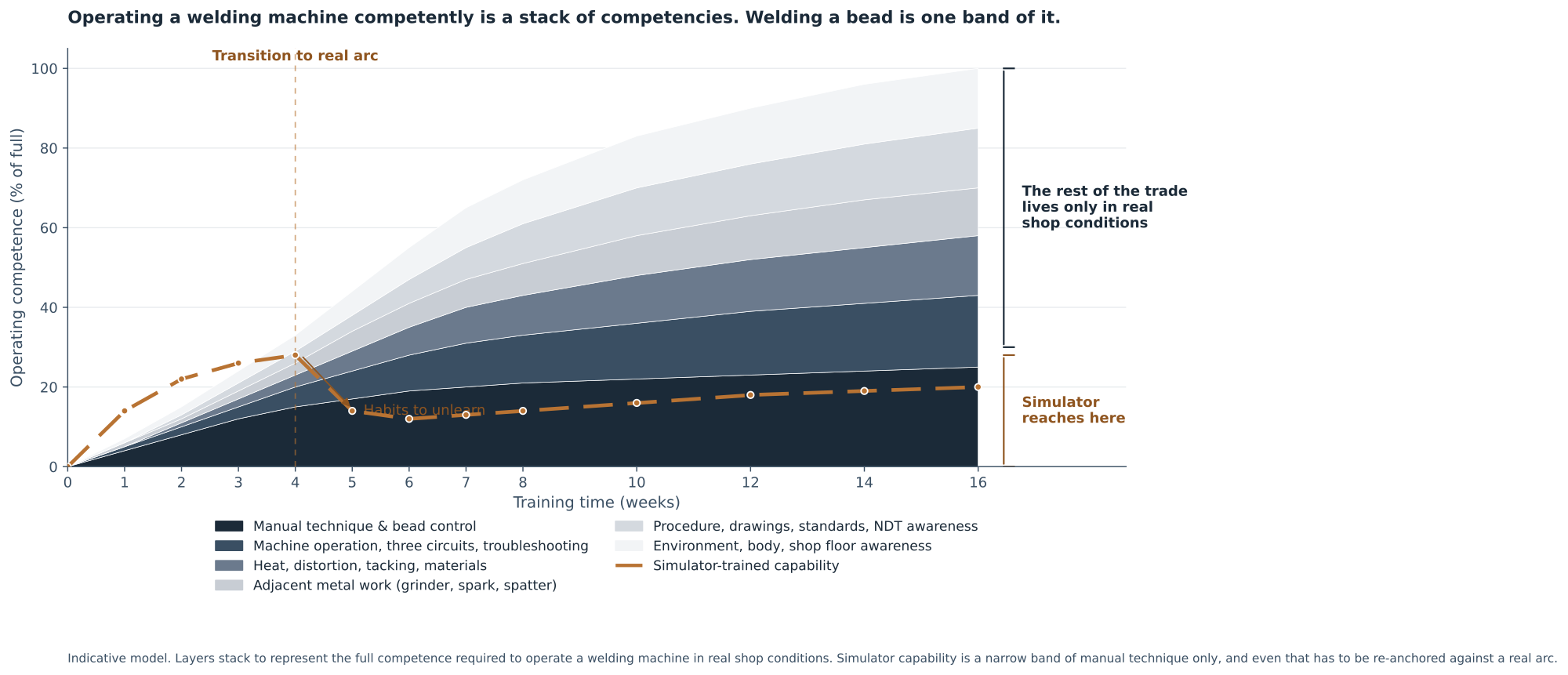
Figure 1. The welding competence stack: what sits underneath the bead.
The Simulator Question
Into this trade, over the past decade, the AR and VR welding simulator industry has sold a promise: muscle memory before the first arc. Faster training, cheaper consumables, fewer accidents, more welders certified. The hardware / firmware is seemingly impressive. The question the brochures never answer is the one this paper’s earlier work put on the table: muscle memory of what?
Lets put aside ‘there is no such thing as muscle memory’. This is an important fact when you understand the learning methodology and mechanism of welder’s.
The term “muscle memory” is misleading. Muscles do not store memory. What people call muscle memory is a form of procedural memory built inside the nervous system. When you repeat a movement, the brain strengthens the connexions between specific parts of the brain (motor cortex, cerebellum and basal ganglia), and coordinates them with visual and sensory feedback from the eyes and hands. Over time these neural pathways become more efficient, so the action can be executed with less conscious thought. The skill lives in the brain and its links to the hands and eyes, not in the muscle tissue itself.99
If we train the brain connexions incorrectly by ‘looking at the incorrect spot’ for the feedback, (exactly when currently simulators do) we have to untrain it, modify the habit, which is more difficult and time consuming than training from a clean slate.
The claims and their provenance
The most aggressively marketed platform in Australia is Soldamatic by Seabery, rolled out by Weld Australia across its Advanced Welder Training Centres in TAFEs around the country. The headline figures repeated across Seabery’s materials and echoed on Weld Australia’s own Soldamatic pages are 34 per cent more welders certified, 56 per cent less training time, 68 per cent training cost saving and 84 per cent fewer accidents.100
As at July 2026, searching for this paper could not locate a methodology document, a named independent study or a peer-reviewed replication of any of those four numbers, and either organisation is welcome to supply one. Until then, the provenance chain ends at the vendor’s marketing, and when the industry body reproduces the vendor’s figures without independent verification, repetition is doing the work corroboration should be doing. It is worth stating the structural facts plainly and without imputation:
Weld Australia both promotes Soldamatic and operates the Advanced Welder Training Centre network built around it. A body that sets the evidentiary bar for the industry should apply that bar to products it helps deploy.101
Lincoln’s VRTEX, Miller’s AugmentedArc, Realityworks’ guideWELD and Fronius’s Welducation make versions of the same pitch with varying restraint, Fronius the most conservative, positioning simulation explicitly as a complement to live training.
What the independent evidence actually shows
The academic literature, read carefully, supports a narrow claim and refutes a broad one.
The most credible synthesis is the 2022 systematic review of 42 studies on VR and AR welding training by Chan, Haron, Isham and Mohamed, which found measurable benefit at entry level for novice trainees and called explicitly for guidelines to ensure skill transfer is engineered into programs rather than assumed.102 The strongest individual studies point the same way. Iowa State’s controlled work found a 50-50 blend of simulated and live training matched or bettered traditional training for basic joints at lower consumable cost, while full VR without live arc time was inferior for harder positions.103
The best randomised comparison, 101 students assigned across live, VR and mixed conditions for introductory GMAW, found no significant differences between groups after a single session: VR was as good as live for first exposure, and no better.104
That is the supportive evidence, in full. Entry level, basic joints, blended programs, short horizons. Nothing in the peer-reviewed record supports simulator hours as a substitute for arc hours in producing an employable welder, and the 2025 wave of studies claiming otherwise dissolves on contact. One ran twenty novices for two weeks with no control group and scored them against the simulator’s own targets. Another claimed ‘high transfer’ to a real task that was a bench exercise, in a paper whose own abstract slides between welding and soldering.105 A trainee getting better at hitting a simulator’s target is evidence that people improve at what they practise. It is not evidence that the simulator builds a welder.
The key point of this is ‘limited funding’ to develop competent welders. There has been minimum of $30 million spent on simulators in the last ten years, mainly by governments. And a minimum of $5 million in eighteen months, the period Jan 1, 2024 to June 30, 2025106
We can NOT do without real welding machines and the competence stack approach training they provide.
I do ‘question the value’ of the simulators; the fact they are a computer and age as such. At about 5 years they are of questionable relevance and the technology / hardware is being replaced. This is seen in the promotion of the Weld Australia ‘ArcAhead’ program.107
I know of welding machines in the training space that are 20 years old and still provide valuable learning opportunities, or at the very least have a resale value to industry.
The question is: What is the tangible improvement, real value and genuine ROI over traditional welding machines;
-
Given the usable and relevant life span of the hardware of the simulators?
-
Can we afford both real welding machines and simulators?
-
Should the limited funding be refocused into advanced welding machines and equipment for training and influence of industry, think advanced wave form technology, advanced features in modern equipment, remote monitoring, mechanisation such as tractors, and cobots / robots?
To me the answer in blindingly obvious. And not considering these factors and acting with is detrimental to the industry.
The pub test is, if the simulators where that good of an investment, every fabrication shop would have one.
Why the transfer gap is structural, not a software version away
The motor learning literature explains why the gap will not close with better graphics.
Skill transfer is governed by specificity of practice: what is learned is bound to the sensory conditions under which it was learned, and removing a trained-with feedback source degrades performance more, not less, as practice accumulates.108 Continuous augmented feedback, which is precisely what a simulator provides through its angle, speed and distance overlays, creates dependency: performance collapses when the guidance is withdrawn, a finding old enough to have a name, the guidance hypothesis.109 Negative transfer is maximised exactly where simulators sit: similar stimuli demanding subtly different responses.110
And the VR-specific literature carries a documented case directly on point: surgical simulator training with inadequate haptic fidelity produced no transfer to the operating theatre.111
Now put the welder’s actual perceptual world against the simulator’s. The experienced welder’s eyes live on the leading edge of a molten pool roughly six to ten millimetres across, reading viscosity, wetting and toe behaviour, while the hand holds position tolerances near a millimetre to ensure the wire is located in the ‘right spot of the weld pool’.
Instrumented-welder research confirms gaze position relative to the pool as a skill marker, and the wider expertise literature shows expert gaze is anchored, task-relevant and feed-forward while novice gaze wanders.112
The simulator cannot render that pool, so it trains the trainee to watch something else: a score, a target zone, a coloured bar. Meanwhile the current generation of hardware carries torch-tracking errors of three to ten millimetres, several times coarser than the control precision the trade demands, a limitation documented by the simulator engineering literature itself.113 The same paper concedes the tracking degrades when the operator moves, so the system quietly trains a still head, and a still head is the opposite of what a real welder’s body does over a live pool: tilting for perspective, shifting to dodge the plume.
The comparison the vendors invite, aviation, is the comparison that undoes the pitch. Flight simulation works because a Level D simulator reproduces the pilot’s entire perceptual interface at a fidelity costing twelve to twenty million US dollars, and even then the research treats simulator hours as a supplement whose substitution value declines with every hour, never a replacement.114
Surgical VR transfers where the simulator reproduces the real perceptual interface, a screen-mediated view, almost exactly, and fails where the haptics diverge.115
A welding simulator retails for a five-figure sum, tens of thousands of dollars at the top of the range, and attempts to fake the one thing in the trade that is hardest to fake: a molten pool under gravity, read through an auto-darkening lens at reading distance. The physics is absent, so is the heat, fumes, dust the ‘environment we need to know if the student is comfortable in’. The dynamic range is wrong. The pool is an animation.
What simulators are actually for
The position is not anti-technology. It is anti-substitution, anti-diversion / dilution of limited training funds but I concedes a real narrow role which this equipment can play and the independent evidence supports.
Simulators earn their keep in schools were safety is an issue, but even here they must be supported by ‘real welders’. Maybe a taster tools, giving a candidate a fast, safe read on coordination, procedural compliance and helmet tolerance before anyone commits to consumables. They carry the first hour or two with a gun safely: stance, travel direction, not lighting anyone up. They can run early angle-and-speed drills with instant feedback, with the trainer in the room and a real machine waiting.
Used that way, at the very front of an experience that then moves quickly to the arc, they save money and reduce risk.
I do question the use of simulators at trade shows and fares, I am of the opinion they do more harm than good.
Why? In my practical experience, I have seen a politician or other non-welder else use a simulator, lift the helmet and say ‘Gee, that’s not that hard’ and the score they achieve reflects that. I am of the opinion this undermines the trade and is an injustice, distorts the perception of training effort and funds that are required to genuinely produce competent welders.
To be fair to the vendors, most of them now pitch blends rather than substitution, Fronius most explicitly. The risk sits in three places the pitch never mentions: headline percentages that imply substitution economics no independent study supports, the dilution of the training fund pool away from ‘real equipment’ and the quiet drift in practice, where providers stretch the simulated portion because it drives unit cost down, count simulator hours as arc hours, and sign off a generation of trainees who have optimised for a score no employer will ever pay for.
The most honest direction in the current research points away from simulation altogether: in-situ AR guidance overlaid on a live arc, keeping the real pool as the teacher and adding metrics on top, measurably helps novices.116 This technology is still in its infancy. The industry should carefully observe the evolution of the technology, stay away from the bleeding edge of technology adoption, and keep asking the vendors the questions the brochures avoid.
-
Muscle memory of what?
-
What is the usable and relevant life span of the hardware of the simulators?
-
How does it simulate the environment, in which the candidates will work?
-
Has the costing and net benefit assumptions taken into account all of the factors?
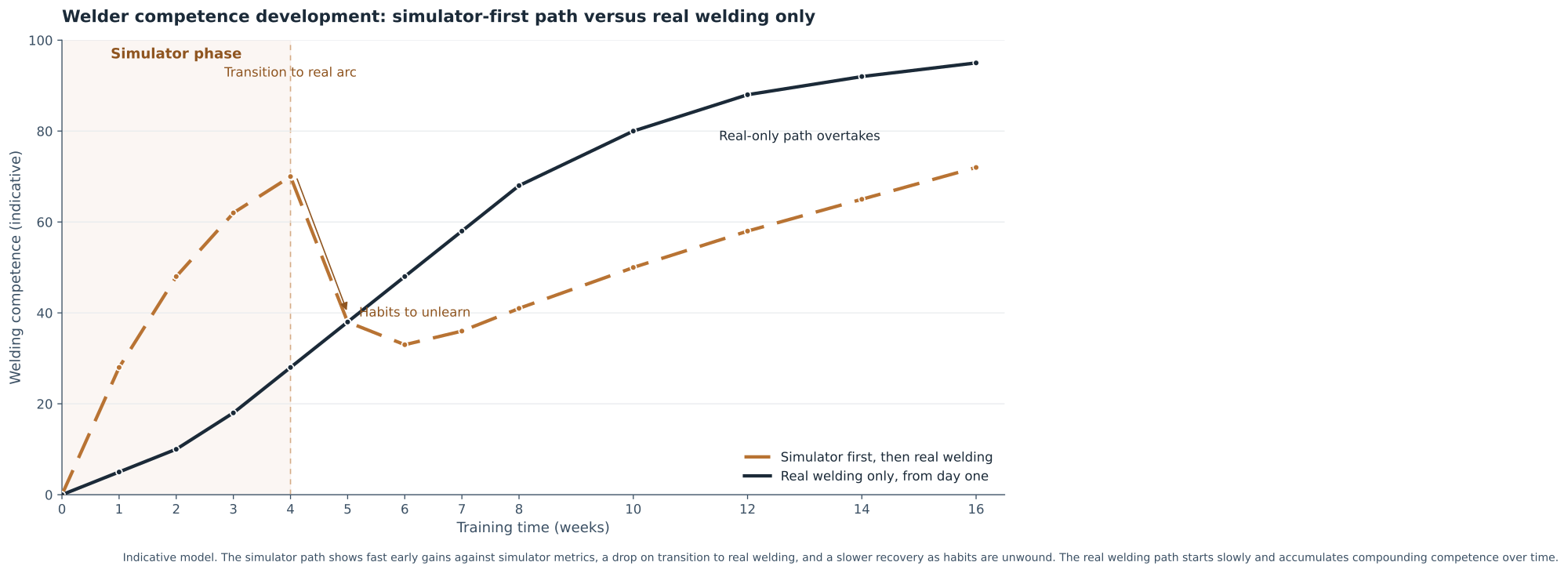
Figure 2. Where simulation legitimately sits in the training path, and where the arc takes over.
Training Systems That Work, and the Voices Missing From Ours
If the diagnosis so far is right, the fix is not mysterious. Other countries run trade training systems that attract capable young people, hold status alongside university, and complete the people they start.
Australia allows the ‘fast tracking’ of Certificate III’s for migrant labour, yet local kids are not provided the same opportunity. I do not advocate for the dilution of the trade. I do however want to see a just system that allows a choice to be available.
None of the solutions got there with marketing. They got there with awareness, structure, and the structures share two features Australia has spent thirty years diluting: employers own the training, and practitioners designing, developing and deliver it.
What the working systems share
Germany’s dual system trains across more than 300 recognised occupations, with firms voluntarily carrying roughly two-thirds of the training cost because the apprentice’s productive work repays it, and around 96 per cent of graduates are employed shortly after their final exams. Germany’s youth unemployment runs at less than half the European average, and the OECD attributes the smooth school-to-work transition substantially to the apprenticeship structure.117
Switzerland sends about two-thirds of its school leavers into vocational training across 230 occupations, including a broad band of academically capable students, and the reason is permeability: the Swiss Federal VET Diploma connects to professional examinations and universities of applied sciences, so no door closes at sixteen.
The NCEE’s study of the Swiss system carries the phrase Australian policy most needs to hear: no dead ends.118
Norway’s two-plus-two model and Denmark’s social-partner-controlled system carry the same DNA, and the Nordic research finds apprenticeship-based routes build stronger occupational identity than school-based VET, which is retention by another name.119
The counterexample is instructive too. The UK reformed apprenticeships through a levy designed in Whitehall: starts by under-19s fell about 40 per cent, achievement rates dropped as low as 55 per cent, and over £600 million was spent on apprenticeships never completed, while employers rebadged existing training to harvest the levy.120 Funding levers without employer ownership do not produce tradespeople. They produce compliance behaviour.
Australia’s structural quirk sits underneath all of this: we train the welder and the fabricator as one person, inside a single flat Certificate III in Engineering (Fabrication Trade), with welding as elective units rather than a streamed trade. The are different things, the student should be able to choose a direction at end of year one or two, at which point they will know, what they enjoy.
Additional the UK splits welders further into pipe and plate welder at Level 3. Germany certifies the welder separately from the metalworking trades through DVS, streamed by fillet, plate and pipe, the same progression the international IIW framework ‘codifies’.
Australia has the coordination / supervision ladder at the top and what is incorrectly referred to as the ‘coding’ regime at the bottom, and an undifferentiated trade certificate in the middle that tells an employer almost nothing about what its holder can weld.121
Our industry qualifications are not aligned to the AQTF framework and there are qualification rungs missing that allow genuine progression to higher education.
That gap is a design flaw other systems fixed decades ago and most academics do not want to discuss.
How five systems structure the welding trade
| System | Welder vs fabricator | Streaming |
| United Kingdom | Separate trades | Pipe and plate welder split at Level 3 |
| Germany | Welder certified separately by DVS | Fillet, then plate, then pipe |
| United States | Distinct occupations, code-based quals | Structural, pipe, combo by code |
| IIW / ISO | Welder separate from coordination ladder | Fillet, plate, pipe (IAB-089) |
| Australia | One flat fabrication Certificate III | None at trade level |
Source: Fry, How the World Trains and Qualifies Welders and Fabricators, 2026.
Same Certificate, Different Road
The questions we need to ask on behalf of our apprentices are;
-
Is the four year apprenticeship model still valid?
-
How do we rationalise a young kid spending four years on a training wage, when migrant labour ends up with the same qualification is a matter of weeks not years?
Let me be clear about where I stand. This is not about diluting the trade or shutting the door on migrant labour. Migrant labour is important. It supplies skills the trade genuinely needs, in the timeframe the country needs them, and recognising overseas competence is a legitimate and necessary thing to do.
The issue is narrower and it is one of fairness. A local kid serves a four year apprenticeship to end up with exactly the same qualification that an overseas worker can obtain through recognition of prior learning in a matter of weeks.
Same certificate, wildly different road to get there. That is an unjust situation, and the structure moving forward needs work, starting with how we differentiate between the two.
At the end of both roads sits the same piece of paper. The local apprentice and the assessed overseas tradesperson both finish holding MEM31922 Certificate III in Engineering, Fabrication Trade, or its current successor MEM31925122.
That single qualification is what gets you recognised as a boilermaker, welder or sheetmetal worker, what underpins skilled migration points, and what an employer reads on a resume and gets you on to mine sites.
The qualification treats the two journeys as equivalent when the paths, and the outcomes they produce, are not.
The migrant route is fast by design. Under Trades Recognition Australia’s Offshore Skills Assessment Program, an applicant needs a formal qualification assessed as equivalent to the Australian Certificate III plus around four years of overseas work experience, then sits a technical interview and a hands on practical test. TRA works to a nominal fifteen week turnaround from the point complete documentary evidence is lodged.
There is no requirement to serve an Australian apprenticeship, no training wage, and no structured exposure to how we actually fabricate and weld to Australian codes. A capable candidate can be deemed trade qualified inside four months. 123.
The domestic route costs four years and a lot of foregone income. The engineering fabrication apprenticeship runs on a nominal 48 month training contract, blending off the job trade school, self paced theory and supervised on the job work 124. Through all of it the apprentice is on a training wage. Under the Manufacturing and Associated Industries and Occupations Award 2020, the qualified C10 tradesperson rate sits at $28.12 an hour, and a first year apprentice earns only a percentage of that, rising by stage across the term125.
So a young Australian carries four years of reduced wages and deferred earnings to reach the exact credential an overseas worker can obtain in fifteen weeks.
Here is the key elements from the shop floor.
The apprenticeship does not just ‘qualify’ that someone can lay a weld on a project. It builds underpinning knowledge over time: distortion control, metallurgy and heat effects, interpreting drawings and welding symbols, and working to AS/NZS 1554 and AS/NZS 1665, alongside welder qualification to standards like ISO 9606.
That understanding is graduated and supervised, and it is why a time served tradesperson can think a job through rather than just run a machine.
A single practical assessment, however well administered, measures a snapshot. It cannot replicate four years of exposure. We end up with no differentiation in qualification and a very real differentiation in outcome, and we are pretending otherwise.
This matters well beyond the trade itself. Formal trade training is the feeder into welding management,. welding supervision, welding inspection, welding technologists and welding engineers.
Every one of those roles is built on a complete understanding of trade theory, competence and know how at the base, and you cannot supervise, inspect or engineer what you have never properly learned to do.
If we keep hollowing out competency development at the trade level, we deplete the entire pipeline above it, and that is a capability the country cannot afford to lose.
So the fix is twofold and the two parts must move together.
First, tighten the recognition pathway so it genuinely tests Australian code competence and underpinning knowledge, with mandatory gap training and a supervised probationary period where the assessment falls short, rather than treating a practical test as the finish line.
Second, give local kids a faster but rigorous domestic pathway, competency based completion and proper recognition of prior learning for adult and lateral entrants, so the same speed available to an overseas worker is available to them too 126.
The challenge is differentiating the two, for that I do not have a answer for yet. We do need to preserve a genuine, time served trade tier, recognised as such, and develop the deep capability the industry actually runs on.
Same ‘fast track’ opportunity for the kids, without dumbing down or diluting what a trade is meant to mean and the value it brings.
The practitioner voice
The most persistent structural failure in Australian trade training is who designs and delivers it. Trade training policy is written, reviewed and reformed by career educationalists, consultants and administrators. The people who have actually walked the path being prescribed, tradespeople who became supervisors, inspectors and engineers, rarely sit on advisory committees and industry reference groups, even more infrequently do they hold the pen on design, funding or assessment policy.
The knowledge argument for practitioners is not romantic. It is epistemological. Polanyi named it sixty years ago: we know more than we can tell, and the knowledge of a skilled trade lives disproportionately in the tacit layer, transferable only through demonstration, shared practice and correction.127
The cognitive apprenticeship literature turned that into pedagogy: modelling, coaching, scaffolding and fading, delivered by someone who holds the expertise in their hands.128 A welder reads a pool the way a radiologist reads a film. Neither can fully articulate the reading, and both can teach it only from beside the learner.
Australia’s system selects against exactly those people.
The Certificate IV in Training and Assessment operates as a gate that keeps gun welders out of training rooms while telling nobody anything about whether its holder can weld.
I have never heard or seen a prospective welding lecturer ‘doing a weld test’ to get the job. This is a problem.
The critique is now academic consensus as well as industry complaint: the VET teaching qualification framework has fallen from degree-level preparation to a compressed certificate that satisfies neither the pedagogy researchers nor the trades.129
Enforcement of vocational currency is weak enough that welding can be taught and assessed by people who have not struck a commercial arc in a decade, could not pass a X Ray weld to a basic standard while TAFE enterprise agreements flatten pay so the exceptional tradesperson earns the same as the time-server, in a market where commercial welding pays more than either.
The 2024 VET Workforce Study found critical trainer shortages in engineering trades, worst outside the cities.130
For honesty’s sake, the counter-case gets stated rather than buried: the research also finds VET teachers with deeper pedagogical qualifications teach better, and the loudest academic critique of Australian VET argues the system suffers from too much industry influence over content, not too little.131
Both points are right and neither rescues the status quo. The synthesis the working systems already run is this: employers and practitioners hold the pen on content and assessment, and trainers are then professionally developed as instructors, the Swiss require about a hundred learning hours of trainer instruction for in-company trainers, targeted at teaching skill rather than generic credentialing. Currency and articulation.
Not a generic Cert IV in TAA in place of either.
The prerequisite structure completes the mismatch. To begin the basic GMAW welding unit in the MEM package, an apprentice must first clear hundreds of hours of front-loaded theory, so the kid who signed up to work with his hands spends most of first year at a desk, which is the exact environment he escaped, administered by the exact method that failed him.132
Employers then report first-year walk-offs and the system files them under attrition, as though the design played no part. Safety theory matters; it belongs integrated with the work it governs, not stockpiled as a barrier in front of it.
The kids just want to weld, pre-requisites steal the real value of a trade learning experience, the doing.
Keeping Them: Retention Is a Design Outcome
Half of Australian apprentices don’t finish. The number has barely moved in a decade, and it is routinely discussed as though it were weather. It is not weather. Every major driver of non-completion is a design choice somebody made, and the evidence on what moves it is unusually clear.
The employment relationship dominates. Completers and non-completers barely differ on training satisfaction; they differ massively on the workplace. Eighty per cent of completers rate their employment experience positively against 42 per cent of non-completers.133 Group training organisations, which wrap apprentices in rotation, pastoral care and a second adult in their corner, complete apprentices at substantially higher rates than small direct employers even after controlling for demographics.134 Mentoring the mentor matters as much as mentoring the apprentice: the highest-completing employers are the ones with organised systems for managing apprentices, which is trainable.
Wages matter differently than assumed. The econometrics finds raising the training wage does little for trade completion; what holds an apprentice is the visible wage premium and near-certain employment waiting at the end.135 Which makes the industry’s real retention tool the one this paper has been arguing for all along: make the journey visible. A first-year who can see the ladder, coded welder, supervisor, inspector, engineer, business owner, prices the hard years correctly. A first-year who thinks the destination is forty years under a helmet in someone else’s shop prices them correctly too, and leaves.
And expectations must be set honestly before day one. The realistic job preview evidence belongs to recruitment, but its retention payload lands here: apprentices who chose the trade knowing the worst of it do not discover the worst of it in month seven. Every walk-off that starts with ‘it wasn’t what I expected’ is a selection failure wearing a retention costume.
None of this requires new discoveries. It requires the system to act on twenty years of its own research: match by interest through tasters, prepare through pre-apprenticeships, place with employers equipped to hold apprentices, wrap the vulnerable ones in GTO-grade support, keep practitioners beside them, and show them the ladder from the first week. Completion is not a mystery. It is a specification.
The Objections, Taken Seriously
A paper that argues against the policy consensus owes its critics their best shot. Here are the strongest objections, stated at full strength and answered.
‘Early leaving ruins lives. Year 12 completion is protective.’ The population-level association is real: early leavers as a group show worse employment and earnings, and the Mitchell Institute has costed lifetime disengagement in the tens of billions.136
But the association is driven by where early leavers go, and most go nowhere, which is the actual harm. This paper does not argue for leaving education. It argues for changing rooms inside it. An apprenticeship is full-time education under the earning-or-learning rules, a Certificate III counts alongside Year 12 in the national attainment measure, and the matched evidence says the non-academic male on that pathway does at least as well as his Year 12 twin, and better on wages.137
The catastrophe statistics describe the kid who drifts out the gate. The proposal here is that he walks out the gate into a contract, a wage and an adult who expects things of him.
‘Lifetime earnings favour the degree.’ On average, yes, and this paper says so in plain terms. At the margin where the actual decision lives, the low-ATAR male choosing between a generalist degree and a trade, the Grattan analysis and the LSAY matched comparisons favour the trade. Averages are not advice.
‘Aptitude testing is validated science.’ It is, and the same science downgraded it in 2022 and has always shown it predicts training scores better than working performance. The argument is not to discard measurement but to move it: from paper gates to work samples, trials and structured interviews, the methods that now top the validity tables and that Swiss employers demonstrate at national scale.
‘The simulator evidence is positive.’ At entry level, in blends, over short horizons, it is, and this paper concedes that role without reservation. What the record does not contain, anywhere, is independent evidence that simulator hours substitute for arc hours in producing employable welders, and the burden of proof for that substitution sits with the people selling it.
Four vendor percentages repeated for a decade without a methodology document is not an evidence base. It is a brochure.
‘Questioning the 70,000 figure undermines the industry’s advocacy.’ The opposite. Advocacy built on a number that collapses under one arithmetic check is a liability waiting for a hostile analyst to find it, and the first casualty when it falls is the credibility of the real gap.
A verifiable shortfall of 25,000 to 30,000 against a workforce of about 75,000, sitting alongside a 57 per cent trade vacancy fill rate on official data, is one of the strongest workforce cases in the country. The industry does not need a bigger number. It needs a defensible one, and it should hold its own advocacy to the standard it would demand of any Welding Procedure: show the workings.
‘If the shortage is real, why not fix it with wages, women and robots?’ All three deserve straight answers.
Wages: welder pay has risen without closing the gap, and the econometrics says the completion lever is the visible destination premium, not the training stipend; pay matters, and it is not the binding constraint on intake.
Women: at around one to a few per cent of the welding workforce, women are the largest untapped pool in the trade, and every reform in this paper, taster selection, realistic previews, better workplaces, visible ladders, applies to them without modification; the paper’s focus on disengaged boys reflects where the current natural intake sits, not where the future one has to stop.
Automation: robots are eating the repetitive fraction of the work, which is real, but the shortage is concentrated in exactly the high competence, positional, site and repair work that resists automation, and every robot cell still needs a competent welder to set it up and inspect the ouput. None of the three substitutes for fixing the pipeline.
‘Boys’ disengagement reflects wider social factors, not schools.’ Partly true, and family disruption effects are real but modest once selection is controlled. It changes nothing operationally. Schools cannot fix family structure; they can stop running an environment that compounds it, and the stage-environment fit literature plus every applied-learning evaluation in this paper shows the environment is the tractable variable.
‘This romanticises the trade. Plenty of tradespeople burn out, get injured, or leave.’ Correct, and the honest ledger stays honest: the satisfaction premium attaches to skilled craft work in decent workplaces, not to manual labour generally, and the trade’s injury, fume and burnout realities are exactly why this paper insists on realistic previews, better workplaces and visible progression rather than recruitment posters. Selling the trade falsely would reproduce the same attrition from the other direction.
‘You are an industry trainer arguing for industry-led training.’ Declared plainly: Technoweld trains welders commercially, and I have skin in this game. So does every academic who reviews the sector from inside a university that competes for the same school leavers.
My primary rationale for developing this paper is to support the industry that has given me so much, to highlight what are the real issues that need to be discussed and provide a voice for the ‘young boy/s at the back of the classroom’. Because I am in a position to, I have walked the path they may choose to take, I have empathy for their plight and they deserve to not be forgotten.
The response is the evidence, which was chosen adversarially: the strongest sources available, primary wherever possible, counter-findings cited alongside, and every load-bearing claim footnoted so the reader can check the working. Where the evidence is thin, campaign evaluations, trade-to-trade mobility data, live-arc gaze research, the paper says so rather than papering over it.
What Needs to Happen
Fourteen years separate the NSW Auditor-General’s warning about warehoused Year 11s from today, and twenty-four from Boys: Getting it Right. The evidence has been sitting in the record the whole time. What has been missing is the will to act on it and the practitioners at the table when anyone tried.
Seven moves, none of them are hard or unrealistic.
Open real trade pathways at end of Year 10, not as a bin for the difficult kids but as a first-class stream with school-based apprenticeships, trade tasters across multiple trades, genuine full time multi trade pre-apprenticeship progams and the academic layer explicitly available later. Judge schools on apprenticeship placements and completions alongside ATARs, and resource career advice with people who actually know what ‘welding is’ and the value it offers.
Promote trades collectively. One national, evaluated, industry-funded campaign for trade careers as a category, built around the journey-not-destination story and the honest earnings ledger, with multi-trade tasters as its call to action. Stop splitting thin budgets to fight over the same cohort.
Select by trial, not by paper. Replace aptitude–score gates with work samples, realistic job previews and taster placements, and use LLN screening to plan support rather than to exclude. Publish completion rates by selection method and let the evidence compound.
Put practitioners back in the middle. Stream the welder within or alongside the fabrication trade, aligned to the international fillet-plate-pipe progression. Let demonstrated trade mastery plus targeted instructor development qualify a trainer, and pay the gun welder what it takes to get them teaching. Give employers and practitioners the pen on content and assessment.
Revisit the current situation with the ‘fast track’ Certificate III exclusively marketed to migrant labour versus the four year ‘training wage’ apprenticeship model for Certificate III. Is it fair to have the ‘Same Certificate, Different Road’? Is it in the industries best interest? Do we need a different qualification, to differentiate? Speak to those that understand the trade, have walked the path, can provide insight and work towards a ‘just’ model that provides choice for the kids considering a trade and the industry more broadly.
Use simulators for what they are, at high school for first exposure at the front of a program, understand the limitations, the lack of environmental aspects, consider the real wholistic ‘Value and ROI’ and count only arc hours as arc hours. Require independent, published evidence for any claim that simulation substitutes for live training before public money buys another unit, and treat vendor-distributor relationships inside standards bodies as the conflicts they are.
Design for completion. Interest-matched intake, prepared through pre–apprenticeships, placed with employers equipped for apprentices, GTO-grade support for the vulnerable, mentors resourced and named, create the genuine links to higher education / welding engineering and the ladder from tradesperson to engineer shown to every first–year in their first week.
None of this is radical. Most of it is thirty years old and running successfully in countries we happily benchmark against for everything except the thing they do best.
What would be radical is another decade of doing what we have always done, spending what we have always spent, reforming what we have always reformed, and standing in front of the same empty welding bays wondering where the next generation went.
They were in Year 9 the whole time.
We need to provide the model for them to get there, demonstrate belief in them and show them they were worth building.
To do that someone has to acknowledge the issue is;
-
its NOT the ‘young boy at the back of the classroom.’
-
it is what we are not doing,
-
what we are failing to address,
-
that the system is the problem and
Select Bibliography
The principal published sources relied on in this paper, alphabetically. Full citations, including standards, statistical series, vendor materials and web sources, are carried in the footnotes where each claim is made.
Ackerman, P. (1988). Determinants of individual differences during skill acquisition. Journal of Experimental Psychology: General, 117(3), 288-318.
Allan, B., Batz-Barbarich, C., Sterling, H. and Tay, L. (2019). Outcomes of meaningful work: A meta-analysis. Journal of Management Studies, 56(3), 500-528.
Arain, M. et al. (2013). Maturation of the adolescent brain. Neuropsychiatric Disease and Treatment, 9, 449-461.
Audit Office of New South Wales (2012). The Impact of the Raised School Leaving Age. Sydney: Audit Office of NSW.
Bandura, A. (1977). Self-efficacy: Toward a unifying theory of behavioral change. Psychological Review, 84, 191-215.
Barrick, M. and Mount, M. (1991). The Big Five personality dimensions and job performance: A meta-analysis. Personnel Psychology, 44(1), 1-26.
Bednarz, A. (2014). Understanding the Non-completion of Apprentices. Adelaide: NCVER.
Blakemore, S.-J. and Choudhury, S. (2006). Development of the adolescent brain: implications for executive function and social cognition. Journal of Child Psychology and Psychiatry, 47(3-4), 296-312.
Byrnes, J., Miller, D. and Schafer, W. (1999). Gender differences in risk taking: A meta-analysis. Psychological Bulletin, 125(3), 367-383.
Cakitaki, B., Norton, A. et al. (2019). Risks and Rewards: When is Vocational Education a Good Alternative to Higher Education? Melbourne: Grattan Institute.
Chan, V. S., Haron, H. N. H., Isham, M. I. B. M. and Mohamed, F. B. (2022). VR and AR virtual welding for psychomotor skills: a systematic review. Multimedia Tools and Applications, 81, 12459-12493.
Clarke, K. (2025). Nationally Recognised Training in Manufacturing: An Exploration of the Current Experience Across Australia. Manufacturing Skills Alliance.
Collins, A., Brown, J. S. and Newman, S. E. (1989). Cognitive apprenticeship. In Resnick, L. (ed.), Knowing, Learning, and Instruction. Hillsdale: Erlbaum.
Covington, M. (1992). Making the Grade: A Self-Worth Perspective on Motivation and School Reform. Cambridge: Cambridge University Press.
Crawford, M. (2009). Shop Class as Soulcraft: An Inquiry into the Value of Work. New York: Penguin.
Crede, M., Tynan, M. and Harms, P. (2017). Much ado about grit: A meta-analytic synthesis. Journal of Personality and Social Psychology, 113(3), 492-511.
Cully, M. and Curtain, R. (2001). Reasons for New Apprentices’ Non-completions. Adelaide: NCVER.
de Boer, H., Bosker, R. and van der Werf, M. (2010). Sustainability of teacher expectation bias effects on long-term student performance. Journal of Educational Psychology, 102(1), 168-179.
Department of Education (2014). Trade Training Centres in Schools Program Independent Review. Canberra: Commonwealth of Australia.
DuBois, D., Portillo, N., Rhodes, J., Silverthorn, N. and Valentine, J. (2011). How effective are mentoring programs for youth? Psychological Science in the Public Interest, 12(2), 57-91.
Earnest, D., Allen, D. and Landis, R. (2011). Mechanisms linking realistic job previews with turnover: A meta-analytic path analysis. Personnel Psychology, 64(4), 865-897.
Eccles, J. et al. (1993). Development during adolescence: The impact of stage-environment fit. American Psychologist, 48(2), 90-101.
Eden, D. and Shani, A. (1982). Pygmalion goes to boot camp: Expectancy, leadership, and trainee performance. Journal of Applied Psychology, 67(2), 194-199.
Ertl, B. and Hartmann, F. (2022). Influence of person-vocation fit on satisfaction and persistence in vocational training programs. Frontiers in Psychology, 13, 834543.
Firth, J. (2020). Review into Vocational and Applied Learning Pathways in Senior Secondary Schooling. Melbourne: Victorian Government.
Fry, G. (2026). Welding Simulators and the Competence Question. Adelaide: Technoweld.
Fry, G. (2026). How the World Trains and Qualifies Welders and Fabricators. Adelaide: Technoweld.
Fry, G. (2026). The Welder Dilemma: A Detailed Submission on Welding Workforce Capability. Adelaide: Technoweld.
Gore, J. et al. (2019). Choosing VET: Investigating the VET Aspirations of School Students. Adelaide: NCVER.
Goss, P. and Sonnemann, J. (2017). Engaging Students: Creating Classrooms that Improve Learning. Melbourne: Grattan Institute.
Hackman, J. R. and Oldham, G. (1976). Motivation through the design of work. Organizational Behavior and Human Performance, 16, 250-279.
Hargreaves, J., Stanwick, J. and Skujins, P. (2020). Understanding the Value of Pre-apprenticeships. Adelaide: NCVER.
Hays, R., Jacobs, J., Prince, C. and Salas, E. (1992). Flight simulator training effectiveness: A meta-analysis. Military Psychology, 4(2), 63-74.
Henry, K., Knight, K. and Thornberry, T. (2012). School disengagement as a predictor of dropout, delinquency, and problem substance use during adolescence and early adulthood. Journal of Youth and Adolescence, 41(2), 156-166.
Hoffman, N. and Schwartz, R. (2015). Gold Standard: The Swiss Vocational Education and Training System. Washington: NCEE.
House of Representatives Standing Committee on Education and Training (2002). Boys: Getting it Right. Canberra: Commonwealth of Australia.
Humphrey, S., Nahrgang, J. and Morgeson, F. (2007). Integrating motivational, social, and contextual work design features. Journal of Applied Psychology, 92(5), 1332-1356.
Hunter, J. and Hunter, R. (1984). Validity and utility of alternative predictors of job performance. Psychological Bulletin, 96(1), 72-98.
Hyde, J. (2005). The gender similarities hypothesis. American Psychologist, 60(6), 581-592.
Jobs and Skills Australia (2025). 2025 Occupation Shortage List: Key Findings Report. Canberra: JSA.
Joyce, S. (2019). Strengthening Skills: Expert Review of Australia’s Vocational Education and Training System. Canberra: Commonwealth of Australia.
Jussim, L. and Harber, K. (2005). Teacher expectations and self-fulfilling prophecies. Personality and Social Psychology Review, 9(2), 131-155.
Karmel, T. and Mlotkowski, P. (2010). The Impact of Wages and the Likelihood of Employment on the Probability of Completing an Apprenticeship or Traineeship. Adelaide: NCVER.
Karmel, T., Lim, P. and Misko, J. (2011). Attrition in the Trades. Adelaide: NCVER.
Lamb, S. and Huo, S. (2017). Counting the Costs of Lost Opportunity in Australian Education. Melbourne: Mitchell Institute.
Law, B. et al. (2004). Eye gaze patterns differentiate novice and experts in a virtual laparoscopic surgery training environment. Proceedings of the 2004 Symposium on Eye Tracking Research and Applications, 41-48.
Levac, D., Huber, M. and Sternad, D. (2019). Learning and transfer of complex motor skills in virtual reality: a perspective review. Journal of NeuroEngineering and Rehabilitation, 16, 121.
Lim, P. and Karmel, T. (2011). The Vocational Equivalent to Year 12. LSAY Research Report 58. Adelaide: NCVER.
Linder, S. et al. (2024). Age- and sex-related changes in motor functions. Frontiers in Aging Neuroscience, 16.
McLanahan, S., Tach, L. and Schneider, D. (2013). The causal effects of father absence. Annual Review of Sociology, 39, 399-427.
McNatt, D. B. (2000). Ancient Pygmalion joins contemporary management: A meta-analysis. Journal of Applied Psychology, 85(2), 314-322.
Misko, J., Korbel, P. and Blomberg, J. (2017). VET in Schools Students: Characteristics and Post-School Employment and Training Experiences. Adelaide: NCVER.
NCVER (2022). Building Capability and Quality in VET Teaching. Adelaide: NCVER.
NCVER (2025). Apprentice and Trainee Outcomes 2025; Apprentice and Trainee Completion Rates 2024. Adelaide: NCVER.
Negrini, L., Forsblom, L., Gurtner, J. and Schumann, S. (2016). Is there a relationship between training quality and premature contract terminations in VET? Vocations and Learning, 9, 361-378.
Newton, P. (2015). The learning styles myth is thriving in higher education. Frontiers in Psychology, 6, 1908.
Nonaka, I. and Takeuchi, H. (1995). The Knowledge-Creating Company. New York: Oxford University Press.
Nye, C., Su, R., Rounds, J. and Drasgow, F. (2012). Vocational interests and performance: A quantitative summary of over 60 years of research. Perspectives on Psychological Science, 7(4), 384-403.
OECD (2015). The ABC of Gender Equality in Education. Paris: OECD Publishing.
OECD (2022). Vocational Education and Training in Germany. Paris: OECD Publishing.
OECD (2022). Vocational Education and Training in Norway. Paris: OECD Publishing.
OECD (2023). PISA 2022 Results: Country Notes, Australia. Paris: OECD Publishing.
Oreopoulos, P. (2006). The compelling effects of compulsory schooling: Evidence from Canada. Canadian Journal of Economics, 39(1), 22-52.
Osgood, C. (1949). The similarity paradox in human learning: a resolution. Psychological Review, 56(3), 132-143.
Pashler, H., McDaniel, M., Rohrer, D. and Bjork, R. (2008). Learning styles: Concepts and evidence. Psychological Science in the Public Interest, 9(3), 105-119.
Peters, M. (1990). Marked sex differences on a fine motor skill task disappear when finger size is used as covariate. Neuropsychologia, 28(11).
Phillips, J. (1998). Effects of realistic job previews on multiple organizational outcomes: A meta-analysis. Academy of Management Journal, 41(6), 673-690.
Pischke, J.-S. and von Wachter, T. (2008). Zero returns to compulsory schooling in Germany. Review of Economics and Statistics, 90(3), 592-598.
Polanyi, M. (1966). The Tacit Dimension. New York: Doubleday.
Productivity Commission (2011). Vocational Education and Training Workforce. Canberra: Productivity Commission.
Proteau, L., Marteniuk, R. and Levesque, L. (1992). A sensorimotor basis for motor learning: Evidence indicating specificity of practice. Quarterly Journal of Experimental Psychology, 44A(3), 557-575.
Reeves, R. (2024). The case for helping boys and men in education. Journal of Policy Analysis and Management, 43(2), 614-622.
Roscoe, S. (1971). Incremental transfer effectiveness. Human Factors, 13(6), 561-567.
Roth, P., Bobko, P. and McFarland, L. (2005). A meta-analysis of work sample test validity. Personnel Psychology, 58(4), 1009-1037.
Rubie-Davies, C. et al. (2015). A teacher expectation intervention. Contemporary Educational Psychology, 40, 72-85.
Sackett, P., Zedeck, S. and Fogli, L. (1988). Relations between measures of typical and maximum job performance. Journal of Applied Psychology, 73(3), 482-486.
Sackett, P., Zhang, C., Berry, C. and Lievens, F. (2022). Revisiting meta-analytic estimates of validity in personnel selection. Journal of Applied Psychology, 107(11), 2040-2068.
Salmoni, A., Schmidt, R. and Walter, C. (1984). Knowledge of results and motor learning: A review and critical reappraisal. Psychological Bulletin, 95(3), 355-386.
Schmidt, F. and Hunter, J. (1998). The validity and utility of selection methods in personnel psychology. Psychological Bulletin, 124(2), 262-274.
Schmitt, D. et al. (2008). Why can’t a man be more like a woman? Sex differences in Big Five personality traits across 55 cultures. Journal of Personality and Social Psychology, 94(1), 168-182.
Sennett, R. (2008). The Craftsman. New Haven: Yale University Press.
Shergold, P. et al. (2020). Looking to the Future: Report of the Review of Senior Secondary Pathways. Education Council.
Sigrist, R. et al. (2013). Augmented visual, auditory, haptic, and multimodal feedback in motor learning: A review. Psychonomic Bulletin and Review, 20(1), 21-53.
Smith, E., Hodge, S. and Yasukawa, K. (2015). Australian VET teacher education: What is the benefit of pedagogical studies at university for VET teachers? TVET@Asia, 5.
Stajkovic, A. and Luthans, F. (1998). Self-efficacy and work-related performance: A meta-analysis. Psychological Bulletin, 124, 240-261.
Stalder, B. and Schmid, E. (2012). Dropping out from apprenticeship training as an opportunity for change. In Transitions and Transformations in Learning and Education. Dordrecht: Springer, 117-130.
Stone, R. T., Watts, K., Zhong, P. and Wei, C.-S. (2011). Physical and cognitive effects of virtual reality integrated training. Human Factors, 53(5), 558-572.
Stone, R. T., McLaurin, E., Zhong, P. and Watts, K. (2013). Full virtual reality versus integrated virtual reality training in welding. Welding Journal, 92(6), 167s-174s.
Symonds, J. et al. (2026). Student engagement declines across adolescence: A meta-analysis of longitudinal studies. Review of Education, 14.
Thomas, D. (2024). Patterns in literacy gender gaps: Examining longitudinal data on boys’ achievements in the Australian NAPLAN test. Studies in Educational Evaluation.
Tierney, J., Grossman, J. and Resch, N. (1995). Making a Difference: An Impact Study of Big Brothers/Big Sisters. Philadelphia: Public/Private Ventures.
Usher, E. and Pajares, F. (2008). Sources of self-efficacy in school: Critical review of the literature and future directions. Review of Educational Research, 78(4), 751-796.
Van Dam, L. et al. (2018). Does natural mentoring matter? A multilevel meta-analysis on the association between natural mentoring and youth outcomes. American Journal of Community Psychology, 62(1-2), 203-220.
Våpenstad, C. et al. (2017). Lack of transfer of skills after virtual reality simulator training with haptic feedback. Minimally Invasive Therapy and Allied Technologies, 26(6), 346-354.
Watterston, J. and O’Connell, M. (2019). Those Who Disappear. Melbourne: Melbourne Graduate School of Education.
Wells, T. and Miller, G. (2020). The effect of virtual reality technology on welding skill performance. Journal of Agricultural Education, 61(1), 152-171.
Wheelahan, L. (2016). After competency-based training: deepening critique, broadening debate. International Journal of Training Research, 14(3).
Download the full paper
The complete position paper. 54 pages, every claim footnoted, with a select bibliography.
Related from Graham Fry
- Customised welder training and mentoring: building competent tradespeople, not just certificates.
- Welding management system development: ISO 3834 and AS/NZS 5131 done properly.
- More technical resources from Technoweld.
- About Graham Fry: welder, International Welding Engineer, 30 years on the tools and in the standards.
-
American Welding Society, Welding Workforce Data, weldingworkforcedata.com, 2025; Jobs and Skills Australia occupation and industry data; Manufacturing Industry Skills Alliance demand modelling. The pro-rata derivation and the audit of the 70,000 figure are set out in the opening chapter.↩︎
-
Audit Office of New South Wales, The Impact of the Raised School Leaving Age, 2012; P. Lim and T. Karmel, The Vocational Equivalent to Year 12, NCVER LSAY Research Report 58, 2011.↩︎
-
A. Bandura, ‘Self-efficacy: Toward a unifying theory of behavioral change’, Psychological Review 84, 1977; L. Jussim and K. Harber, ‘Teacher expectations and self-fulfilling prophecies’, Personality and Social Psychology Review 9(2), 2005; S. Humphrey, J. Nahrgang and F. Morgeson, meta-analysis of work design, Journal of Applied Psychology 92(5), 2007.↩︎
-
P. Sackett, C. Zhang, C. Berry and F. Lievens, ‘Revisiting meta-analytic estimates of validity in personnel selection’, Journal of Applied Psychology 107(11), 2022; A. Bednarz, Understanding the Non-completion of Apprentices, NCVER, 2014.↩︎
-
Weld Australia, ‘Overcoming Australia’s Welding Skills Crisis’, weldaustralia.com.au. First published around 2022 and maintained in current materials.↩︎
-
Jobs and Skills Australia, occupation profile 3223, Structural Steel and Welding Trades Workers.↩︎
-
American Welding Society, Welding Workforce Data, weldingworkforcedata.com; AWS Welding Digest, ‘Where Are the Welders?’, October 2025.↩︎
-
Manufacturing Industry Skills Alliance demand modelling; Jobs and Skills Australia data. The pro-rata calculation: 320,500 scaled by Australia’s population share of approximately 8 per cent yields around 26,000.↩︎
-
Jobs and Skills Australia, 2025 Occupation Shortage List: Key Findings Report, October 2025, jobsandskills.gov.au.↩︎
-
IW Cologne / KOFA skilled-labour gap analyses, 2023-2026; OECD, Economic Surveys: Germany 2025, ‘Addressing skilled labour shortages’.↩︎
-
UK Department for Education apprenticeship statistics; CIPD apprenticeship levy research, 2024; UK Temporary Shortage List Stage 1 Report, October 2025. Industry estimates of a 36,000 welder shortfall by 2027 circulate widely but trace to industry bodies rather than official statistics.↩︎
-
Weld Australia, 2024 Member Survey Results, weldaustralia.com.au, September 2024.↩︎
-
Australian Steel Institute, national fabricator survey, 2024. A separate figure from a separate source to the Weld Australia member survey result above, though the two point the same way.↩︎
-
NCVER, Apprentices and Trainees 2025: March Quarter; NCVER, Apprentice and Trainee Completion Rates 2024, published 2025. Contract completion rates, which count each employer change as a non-completion, sit lower again, around the low fifties.↩︎
-
NCVER VET Workforce data; Jobs and Skills Australia, 2024 VET Workforce Study.↩︎
-
D. Thomas, ‘Patterns in literacy gender gaps: Examining longitudinal data on boys’ achievements in the Australian NAPLAN test’, Studies in Educational Evaluation, 2024; Centre for Independent Studies analysis of 2025 NAPLAN data.↩︎
-
OECD, PISA 2022 Results: Country Notes, Australia, 2023; OECD, The ABC of Gender Equality in Education, 2015.↩︎
-
Middle Years Engagement Project data; J. Symonds et al., ‘Student engagement declines across adolescence: A meta-analysis of longitudinal studies’, Review of Education, 2026.↩︎
-
P. Goss and J. Sonnemann, Engaging Students: Creating Classrooms that Improve Learning, Grattan Institute, 2017.↩︎
-
QUT-led cohort study, Children and Youth Services Review, 2025.↩︎
-
Australian Institute of Health and Welfare, Australia’s Children; Young Minds Matter survey data. Newer research suggests girls are under-diagnosed and the true ratio is lower, which changes nothing about the absolute number of boys involved.↩︎
-
House of Representatives Standing Committee on Education and Training, Boys: Getting it Right, Commonwealth of Australia, 2002.↩︎
-
J. Eccles et al., ‘Development during adolescence: The impact of stage-environment fit on young adolescents’ experiences in schools and in families’, American Psychologist 48(2), 1993.↩︎
-
S.-J. Blakemore and S. Choudhury, ‘Development of the adolescent brain: implications for executive function and social cognition’, Journal of Child Psychology and Psychiatry 47, 2006; M. Arain et al., ‘Maturation of the adolescent brain’, Neuropsychiatric Disease and Treatment 9, 2013.↩︎
-
R. Reeves, ‘The case for helping boys and men in education’, Journal of Policy Analysis and Management, 2024, reviewing the developmental literature. The behavioural data above stands independently of any neurodevelopmental claim.↩︎
-
P. Newton, ‘The Learning Styles Myth is Thriving in Higher Education’, Frontiers in Psychology 6, 2015; H. Pashler, M. McDaniel, D. Rohrer and R. Bjork, ‘Learning styles: Concepts and evidence’, Psychological Science in the Public Interest 9(3), 2008.↩︎
-
J. Firth, Review into Vocational and Applied Learning Pathways in Senior Secondary Schooling, Victorian Government, 2020.↩︎
-
Audit Office of New South Wales, The Impact of the Raised School Leaving Age, 2012.↩︎
-
J. Watterston and M. O’Connell, Those Who Disappear, Melbourne Graduate School of Education, 2019.↩︎
-
P. Lim and T. Karmel, The Vocational Equivalent to Year 12, NCVER LSAY Research Report 58, 2011. A matched observational comparison, not a randomised one: it describes those who obtained and held trade pathways, so the binding constraint is apprenticeship supply, which is exactly where this paper’s recommendations aim.↩︎
-
P. Oreopoulos, ‘The compelling effects of compulsory schooling’, Canadian Journal of Economics 39, 2006; J.-S. Pischke and T. von Wachter, ‘Zero returns to compulsory schooling in Germany: Evidence and interpretation’, Review of Economics and Statistics 90(3), 2008.↩︎
-
M. Covington, Making the Grade: A Self-Worth Perspective on Motivation and School Reform, Cambridge University Press, 1992.↩︎
-
K. Henry, K. Knight and T. Thornberry, ‘School disengagement as a predictor of dropout, delinquency, and problem substance use during adolescence and early adulthood’, Journal of Youth and Adolescence 41, 2012.↩︎
-
Australian Institute of Criminology, Trends and Issues in Crime and Criminal Justice No. 531, 2020.↩︎
-
Australian Institute of Health and Welfare, Engagement in Education or Employment, 2024.↩︎
-
J. Misko, P. Korbel and J. Blomberg, VET in Schools Students: Characteristics and Post-School Employment and Training Experiences, NCVER, 2017. Selection into these programs is not random; the evidential point is the consistency of direction across program types and decades, not any single estimate.↩︎
-
Longitudinal Surveys of Australian Youth analysis, Department of Education literature review.↩︎
-
NCVER, VET as a Re-engagement Pathway for Early School Leavers.↩︎
-
Deloitte Access Economics evaluation, 2012; dandolo partners analysis, 2021; Hands On Learning impact data, handsonlearning.org.au. Evaluations are program-adjacent and not randomised; cited as promising rather than definitive.↩︎
-
Department of Education, Trade Training Centres in Schools Program Independent Review, 2014.↩︎
-
L. Jussim and K. Harber, ‘Teacher expectations and self-fulfilling prophecies: Knowns and unknowns, resolved and unresolved controversies’, Personality and Social Psychology Review 9(2), 2005.↩︎
-
Jussim and Harber, 2005. See also H. de Boer, R. Bosker and M. van der Werf, Journal of Educational Psychology 102(1), 2010, on the long-term persistence of expectation bias effects.↩︎
-
D. B. McNatt, ‘Ancient Pygmalion joins contemporary management: A meta-analysis of the result’, Journal of Applied Psychology 85(2), 2000; D. Eden and A. Shani, ‘Pygmalion goes to boot camp’, Journal of Applied Psychology 67, 1982. Field-generalisation of these effects is debated; the direction is consistent, the size varies.↩︎
-
C. Rubie-Davies et al., ‘A teacher expectation intervention: Modelling the practices of high expectation teachers’, Contemporary Educational Psychology 40, 2015. A single intervention study awaiting replication at scale.↩︎
-
A. Bandura, ‘Self-efficacy: Toward a unifying theory of behavioral change’, Psychological Review 84, 1977; E. Usher and F. Pajares, ‘Sources of self-efficacy in school: Critical review of the literature and future directions’, Review of Educational Research 78(4), 2008, confirming mastery as the consistently dominant source.↩︎
-
A. Stajkovic and F. Luthans, ‘Self-efficacy and work-related performance: A meta-analysis’, Psychological Bulletin 124, 1998. The relationship is reciprocal, performance builds efficacy as much as the reverse, which strengthens rather than weakens the design implication: engineer early wins.↩︎
-
J. R. Hackman and G. Oldham, ‘Motivation through the design of work’, Organizational Behavior and Human Performance 16, 1976; S. Humphrey, J. Nahrgang and F. Morgeson, ‘Integrating motivational, social, and contextual work design features’, Journal of Applied Psychology 92(5), 2007.↩︎
-
B. Allan, C. Batz-Barbarich, H. Sterling and L. Tay, ‘Outcomes of meaningful work: A meta-analysis’, Journal of Management Studies 56(3), 2019.↩︎
-
M. Crawford, Shop Class as Soulcraft: An Inquiry into the Value of Work, Penguin, 2009; R. Sennett, The Craftsman, Yale University Press, 2008.↩︎
-
NCVER, Apprentice and Trainee Outcomes 2025; Angi Skilled Trades Report 2024, reported in Forbes, 2024. The satisfaction premium attaches to skilled craft work specifically, not manual labour generally.↩︎
-
Australian Bureau of Statistics, Census of Population and Housing, 2021.↩︎
-
S. McLanahan, L. Tach and D. Schneider, ‘The causal effects of father absence’, Annual Review of Sociology 39, 2013. Effects are smaller than raw correlations suggest, and family disruption is a risk factor, not a destiny.↩︎
-
J. Tierney, J. Grossman and N. Resch, Making a Difference: An Impact Study of Big Brothers/Big Sisters, Public/Private Ventures, 1995.↩︎
-
D. DuBois, N. Portillo, J. Rhodes, N. Silverthorn and J. Valentine, ‘How effective are mentoring programs for youth?’, Psychological Science in the Public Interest 12(2), 2011.↩︎
-
L. Van Dam et al., ‘Does natural mentoring matter? A multilevel meta-analysis’, American Journal of Community Psychology, 2018; MENTOR, The Mentoring Effect, 2014.↩︎
-
S. Kanchewa, J. Rhodes et al., research on same- versus cross-gender mentoring matches, 2014; relationship quality and duration are the operative variables.↩︎
-
International Institute of Welding, Qualification and Certification of Personnel; the IWP-IWS-IWT-IWE progression under guideline IAB-252, administered in Australia by Weld Australia as the Authorised National Body.↩︎
-
J. Gore et al., Choosing VET: Investigating the VET Aspirations of School Students, NCVER, 2019; J. Hargreaves and K. Osborne, Choosing VET: Aspirations, Intentions and Choice, NCVER, 2019.↩︎
-
ACER GENERATION survey; Year13/YouthSense, After the ATAR series. See also Youth Insight finding that 77 per cent of students whose parents did not attend university still intend to apply.↩︎
-
Australian Industry Group research on careers advice and trade pathways; commentary by Ai Group Centre for Education and Training, 2024.↩︎
-
S. Joyce, Strengthening Skills: Expert Review of Australia’s Vocational Education and Training System, Commonwealth of Australia, 2019.↩︎
-
P. Shergold et al., Looking to the Future: Report of the Review of Senior Secondary Pathways into Work, Further Education and Training, Education Council, 2020.↩︎
-
Grattan Institute analyses of graduate earnings; A. Norton and I. Cherastidtham, Mapping Australian Higher Education. The premium is real, average, and declining: Census-based analysis shows the bachelor salary advantage fell between 2016 and 2021.↩︎
-
B. Cakitaki, A. Norton et al., Risks and Rewards: When is Vocational Education a Good Alternative to Higher Education?, Grattan Institute, 2019.↩︎
-
QILT, 2024 Graduate Outcomes Survey; NCVER, Apprentice and Trainee Outcomes 2025. The measures differ: the graduate figure is full-time employment among those seeking it, the trade figure is employment of any kind, and most trade completers were employed through their training. The time-in-market and debt differences stand regardless. Undergraduate median starting salary about $71,000-$75,000; specialised and coded welders $90,000-$120,000 and up; site boilermakers on FIFO and shutdown rosters $130,000-$190,000 (SEEK and Jora salary data, 2026).↩︎
-
German Federal Ministry decisions pegging the Meister at EQF Level 6; Berufsbildungsgesetz amendment 2020 creating the Bachelor Professional title; ZDH, The German Meister Qualification Overview, 2022.↩︎
-
T. Karmel, P. Lim and J. Misko, Attrition in the Trades, NCVER, 2011.↩︎
-
Australian Small Business and Family Enterprise Ombudsman, sole trader and small business data, 2026.↩︎
-
J. Hargreaves, J. Stanwick and P. Skujins, Understanding the Value of Pre-apprenticeships, NCVER, 2020.↩︎
-
B. Ertl and F. Hartmann, ‘Influence of person-vocation fit on satisfaction and persistence in vocational training programs’, Frontiers in Psychology 13, 2022, analysing 4,097 German trainees in the National Educational Panel Study.↩︎
-
BIBB, Datenreport zum Berufsbildungsbericht; German Federal Ministry for Economic Affairs, dual vocational training data.↩︎
-
UK Government, Get In Go Far apprenticeship campaign, 2016; the predecessor campaign recorded a 140 per cent rise in apprenticeship helpline contact. Attribution overlaps with concurrent levy policy; cited as indicative.↩︎
-
WorldSkills UK, Skills Competition Evaluation Project; WorldSkills Lyon 2024 impact reporting.↩︎
-
NCVER, Cross-occupational Skill Transferability: Challenges and Opportunities in a Changing Economy; dual-qualification apprenticeships offered at Chisholm Institute and equivalents. Direct longitudinal data on trade-to-trade movement is thin, a genuine evidence gap; the claim rests on attrition parity, transferability analysis and partial-completion employment data.↩︎
-
M. Barrick and M. Mount, ‘The Big Five personality dimensions and job performance: A meta-analysis’, Personnel Psychology 44(1), 1991. Grit, its popular cousin, correlates with conscientiousness at around .84 and adds little beyond it: M. Credé, M. Tynan and P. Harms, ‘Much ado about grit: A meta-analytic synthesis’, Journal of Personality and Social Psychology 113(3), 2017.↩︎
-
B. Ertl and F. Hartmann, Frontiers in Psychology 13, 2022. See also C. Nye, R. Su, J. Rounds and F. Drasgow, ‘Vocational interests and performance’, Perspectives on Psychological Science 7(4), 2012: interest congruence correlates with performance and persistence at levels rivalling ability measures.↩︎
-
Weld Australia, Women in Welding program, weldaustralia.com.au; female apprentice commencements are growing fast, but off that tiny base.↩︎
-
S. Linder et al., ‘Age- and sex-related changes in motor functions’, Frontiers in Aging Neuroscience 16, 2024; Purdue Pegboard norms for 14 to 19 year olds. Men lead on grip strength and finger-tapping speed in the same data.↩︎
-
M. Peters, ‘Marked sex differences on a fine motor skill task disappear when finger size is used as covariate’, Neuropsychologia 28(11), 1990.↩︎
-
National WWII Museum, Rosie the Riveter and women war workers records; Kaiser Richmond shipyard employment records. The Fabricator’s corrective is worth keeping in frame too: ‘Women aren’t better welders; they’re just welders.’↩︎
-
J. Byrnes, D. Miller and W. Schafer, ‘Gender differences in risk taking: A meta-analysis’, Psychological Bulletin 125(3), 1999.↩︎
-
D. Schmitt et al., ‘Why can’t a man be more like a woman? Sex differences in Big Five personality traits across 55 cultures’, Journal of Personality and Social Psychology 94(1), 2008; J. Hyde, ‘The gender similarities hypothesis’, American Psychologist 60(6), 2005.↩︎
-
SALT, Supporting and Linking Tradeswomen, founded by Fi Shewring, saltaustralia.org.au; Shewring’s finding on early tool exposure and apprenticeship success.↩︎
-
Institute for Women’s Policy Research, reports on women in construction trades; NIOSH data on gender harassment; union-supported programs roughly double female completion rates, evidence that the outcomes are structural rather than biological.↩︎
-
F. Schmidt and J. Hunter, ‘The validity and utility of selection methods in personnel psychology’, Psychological Bulletin 124(2), 1998.↩︎
-
P. Sackett, C. Zhang, C. Berry and F. Lievens, ‘Revisiting meta-analytic estimates of validity in personnel selection: Addressing systematic overcorrection for restriction of range’, Journal of Applied Psychology 107(11), 2022; and the companion paper in Industrial and Organizational Psychology 16(3), 2023. The correction methodology is debated, but even critics accept the classical figures were inflated.↩︎
-
J. Hunter and R. Hunter, ‘Validity and utility of alternative predictors of job performance’, Psychological Bulletin 96, 1984.↩︎
-
P. Sackett, S. Zedeck and L. Fogli, ‘Relations between measures of typical and maximum job performance’, Journal of Applied Psychology 73, 1988.↩︎
-
P. Ackerman, ‘Determinants of individual differences during skill acquisition’, Journal of Experimental Psychology: General 117, 1988.↩︎
-
M. Cully and R. Curtain, Reasons for New Apprentices’ Non-completions, NCVER, 2001; A. Bednarz, Understanding the Non-completion of Apprentices, NCVER, 2014.↩︎
-
UK Department for Education, Apprenticeship Evaluation 2023: learner, non-completer and employer surveys.↩︎
-
B. Stalder and E. Schmid, LEVA study, Canton of Bern; ‘Dropping out from apprenticeship training as an opportunity for change’, in Transitions in Vocational Education, Springer, 2012.↩︎
-
P. Roth, P. Bobko and L. McFarland, ‘A meta-analysis of work sample test validity’, Personnel Psychology 58(4), 2005; Sackett et al., 2022.↩︎
-
J. Phillips, ‘Effects of realistic job previews on multiple organizational outcomes: A meta-analysis’, Academy of Management Journal 41(6), 1998; D. Earnest, D. Allen and R. Landis, ‘Mechanisms linking realistic job previews with turnover’, Personnel Psychology 64(4), 2011.↩︎
-
L. Negrini, L. Forsblom, J. Gurtner and S. Schumann, ‘Is there a relationship between training quality and premature contract terminations in VET?’, Vocations and Learning 9, 2016, and the companion Swiss selection-methods study. The Schnupperlehre, the taster apprenticeship, is a standard feature of Swiss recruitment.↩︎
-
Dexterity: An Indicator of Future Performance in Beginning Welders, Career and Technical Education Research 43(2), 2018.↩︎
-
ISO 9606-1; ISO 14732; AS 1796; ISO 14731; ISO 3834 parts 1 to 5. Read together, these describe a competent welding operation, and the manual skill of bead placement is a necessary but small component of it.↩︎
-
The hierarchy framing is developed in G. Fry, The Welder Dilemma: A Detailed Submission on Welding Workforce Capability, Technoweld, 2026. The terminology distinctions rest on AS 1796 and AS/NZS ISO 9606.1 read side by side.↩︎
-
Cleveland Clinic, “Muscle Memory: What It Is and How It Works,” https://my.clevelandclinic.org/health/articles/muscle-memory↩︎
-
Seabery, Soldamatic product materials, seaberyat.com; Weld Australia, Soldamatic Augmented Reality Welding Simulators, weldaustralia.com.au. The figures are reproduced on both.↩︎
-
Weld Australia’s Advanced Welder Training Centre program and its ArcAhead simulator redeployment initiative are documented at weldaustralia.com.au. The observation concerns structure, not motive.↩︎
-
V. S. Chan, H. N. H. Haron, M. I. B. M. Isham and F. B. Mohamed, ‘VR and AR virtual welding for psychomotor skills: a systematic review’, Multimedia Tools and Applications 81, 2022. An earlier revision of this analysis misattributed this review to Stone et al.; the attribution is corrected here.↩︎
-
R. T. Stone, K. Watts, P. Zhong and C.-S. Wei, ‘Physical and cognitive effects of virtual reality integrated training’, Human Factors 53(5), 2011; R. T. Stone, E. McLaurin, P. Zhong and K. Watts, ‘Full virtual reality versus integrated virtual reality training in welding’, Welding Journal 92(6), 2013.↩︎
-
T. Wells and G. Miller, ‘The effect of virtual reality technology on welding skill performance’, Journal of Agricultural Education 61(1), 2020.↩︎
-
Applied Sciences 15(22):12331, 2025; Electronics 14(10):1964, 2025. Both MDPI. Neither includes a production-condition transfer test or an independent comparison cohort.↩︎
-
Weld Australia audited financial reports, FY2024 to the six months ended 30 June 2025 (1.5 reporting periods). Auditor throughout: Thomas GLC Chartered Accountants; every opinion unmodified.↩︎
-
Weld Australia’s Advanced Welder Training Centre program and its ArcAhead simulator redeployment initiative are documented at weldaustralia.com.au. The observation concerns structure, not motive. https://weldaustralia.com.au/news-views/weld-australia-launches-arcahead/↩︎
-
L. Proteau, R. Marteniuk and L. Lévesque, ‘A sensorimotor basis for motor learning: Evidence indicating specificity of practice’, Quarterly Journal of Experimental Psychology 44A(3), 1992.↩︎
-
A. Salmoni, R. Schmidt and C. Walter, ‘Knowledge of results and motor learning: A review and critical reappraisal’, Psychological Bulletin 95(3), 1984; R. Sigrist et al., ‘Augmented visual, auditory, haptic, and multimodal feedback in motor learning: A review’, Psychonomic Bulletin and Review 20, 2013, for the balanced modern treatment.↩︎
-
C. Osgood, ‘The similarity paradox in human learning: a resolution’, Psychological Review 56(3), 1949.↩︎
-
C. Våpenstad et al., ‘Lack of transfer of skills after virtual reality simulator training with haptic feedback’, Minimally Invasive Therapy and Allied Technologies, 2017; D. Levac, M. Huber and D. Sternad, ‘Learning and transfer of complex motor skills in virtual reality: a perspective review’, Journal of NeuroEngineering and Rehabilitation 16, 2019.↩︎
-
Operator skill identification research including welder gaze tracking, arXiv:2402.14388, 2024; B. Law et al., ‘Eye gaze patterns differentiate novice and experts in a virtual laparoscopic surgery training environment’, Eye Tracking Research and Applications, 2004. A mature eye-tracking literature under live arc does not yet exist; the claim rests on emerging instrumented-welder work plus the established cross-domain expertise findings.↩︎
-
Improving VR Welding Simulator Tracking Accuracy Through IMU-SLAM Fusion, Electronics 14(23):4693, 2025, which reports 3-10 mm torch tracking error in current commercial systems and notes the systems require the operator to hold still to avoid tracking drift.↩︎
-
R. Hays, J. Jacobs, C. Prince and E. Salas, ‘Flight simulator training effectiveness: A meta-analysis’, Military Psychology 4(2), 1992; S. Roscoe, ‘Incremental transfer effectiveness’, Human Factors 13(6), 1971.↩︎
-
N. Seymour et al., ‘Virtual reality training improves operating room performance’, Annals of Surgery 236(4), 2002; Cochrane review CD006575, 2013, finding benefit for inexperienced trainees with all trials at high risk of bias.↩︎
-
WeldAR: Augmenting Live Hands-On Training with In-Situ Guidance for Novice Learners, CHI 2026, arXiv:2603.07959. Note what the design concedes: the arc has to be real.↩︎
-
BIBB Cost-Benefit Survey of company training, 2017-18; OECD, Vocational Education and Training in Germany, 2022; German youth unemployment 6.5 per cent against an EU average of 14.6 per cent, 2025. For balance: roughly a third of German training contracts are dissolved before completion, though about half of those re-contract in another firm or occupation, so contract dissolution overstates system dropout.↩︎
-
N. Hoffman and R. Schwartz, Gold Standard: The Swiss Vocational Education and Training System, National Center on Education and the Economy, 2015; Swiss State Secretariat for Education, Research and Innovation VET data.↩︎
-
C. H. Jørgensen et al., ‘Challenges for work-based learning in VET in the Nordic countries’; OECD, VET in Norway, 2022.↩︎
-
UK Department for Education apprenticeship statistics; CIPD apprenticeship levy analysis, 2024. The levy is now being replaced.↩︎
-
The comparison is developed in full in G. Fry, How the World Trains and Qualifies Welders and Fabricators, Technoweld research paper, June 2026, drawing on the UK apprenticeship standards register, the German BIBB and DVS frameworks, and IIW guideline IAB-089.↩︎
-
MEM31922 Certificate III in Engineering, Fabrication Trade, training.gov.au: https://training.gov.au/training/details/MEM31922↩︎
-
Trades Recognition Australia, Offshore Skills Assessment Program (OSAP): https://www.tradesrecognitionaustralia.gov.au/programs/offshore-skills-assessment-program-osap↩︎
-
Engineering trades apprenticeship (nominal 48 month term), Apprenticeships Victoria: https://www.apprenticeships.vic.gov.au/engineering-trade-apprenticeship↩︎
-
Manufacturing and Associated Industries and Occupations Award 2020 [MA000010], Fair Work Ombudsman: https://www.fairwork.gov.au/employment-conditions/awards/awards-summary/ma000010-summary↩︎
-
Trades Recognition Australia, Job Ready Program (JRP): https://www.tradesrecognitionaustralia.gov.au/our-programs/job-ready-program-jrp↩︎
-
M. Polanyi, The Tacit Dimension, Doubleday, 1966; I. Nonaka and H. Takeuchi, The Knowledge-Creating Company, Oxford University Press, 1995, on socialisation as the mechanism of tacit transfer.↩︎
-
A. Collins, J. S. Brown and S. E. Newman, ‘Cognitive apprenticeship: Teaching the crafts of reading, writing, and mathematics’, in Knowing, Learning, and Instruction, Erlbaum, 1989. The same literature notes expertise alone is insufficient: the expert must also be able to make the implicit visible, which is itself a skill.↩︎
-
Productivity Commission, Vocational Education and Training Workforce, 2011, on the ‘dual professional’ requirement; ‘The oversight of VET teacher-education in Australia’, Journal of Vocational Education and Training, 2025; NCVER, Building Capability and Quality in VET Teaching, 2022, documenting how the TAE upgrade mandate pushed experienced trainers out of the sector.↩︎
-
Jobs and Skills Australia, VET Workforce Study, 2024; NCVER VET workforce data: median trainer age 50 against 40 for the general workforce.↩︎
-
E. Smith, S. Hodge and K. Yasukawa, ‘Australian VET teacher education: What is the benefit of pedagogical studies at university for VET teachers?’, TVET@Asia 5; L. Wheelahan, ‘After competency-based training: deepening critique, broadening debate’, International Journal of Training Research 14(3), 2016.↩︎
-
MEM training package prerequisite structures; the issue is documented in Manufacturing Skills Australia’s national review, Nationally Recognised Training in Manufacturing: An Exploration of the Current Experience Across Australia, prepared by Kerrie Clarke, June 2025, which identifies MEM prerequisites as structural impediments and notes RPL functioning ineffectively in practice.↩︎
-
A. Bednarz, Understanding the Non-completion of Apprentices, NCVER, 2014.↩︎
-
NCVER, Completion Rates for Group Training Organisations and Direct Employers: How Do They Compare?↩︎
-
T. Karmel and P. Mlotkowski, The Impact of Wages and the Likelihood of Employment on the Probability of Completing an Apprenticeship or Traineeship, NCVER, 2010. Pay still features in stated reasons for leaving; the point is that the completion lever is the destination, not the stipend.↩︎
-
S. Lamb and S. Huo, Counting the Costs of Lost Opportunity in Australian Education, Mitchell Institute, 2017.↩︎
-
Lim and Karmel, NCVER, 2011; ABS attainment measure combining Year 12 or Certificate III and above. The Mitchell Institute’s own numbers concern detachment, not structured trade pathways.↩︎